| Journal of Clinical Question, 2024, Vol. 1, No. 2, 52–56 https://doi.org/10.69854/jcq.2024.0007 Advance access publication date 25 October 2024 |
 |
Case Report
When Euphoria Turns to Neuropathy: Vitamin B12 Deficiency Related to Nitrous Oxide
California Northstate University College of Medicine, CA, USA.
*Corresponding Author: e-mail: garychumd@gmail.com
Submitted: September 30, 2024 Accepted: October 24, 2024
Clinical Question Box
In patients with chronic nitrous oxide abuse, what is the role of vitamin B12 deficiency in the development of subacute combined degeneration (SCD) of the spinal cord and what is the recommended treatment to prevent permanent neurological damage?
Chronic nitrous oxide abuse can cause functional vitamin B12 deficiency by inactivating cobalamin, leading to SCD of the spinal cord and treatment involves discontinuing nitrous oxide use and administering intramuscular B12; early recognition and intervention are crucial to reverse neurological deficits and prevent permanent damage.
Abstract
Background: Nitrous oxide is a widely abused inhalant known for its rapid onset of euphoric sensations. Chronic use, however, can result in functional vitamin B12 deficiency, causing megaloblastic anemia, peripheral neuropathy, and subacute combined degeneration (SCD) of the spinal cord. Case Presentation: This case report examines a 43-year-old male with a history of attention-deficit/hyperactivity disorder and chronic back pain who presented with neurological symptoms secondary to chronic nitrous oxide use and subsequent B12 deficiency. The patient reported a one-week history of lower extremity swelling, paresthesias, and vertigo. He admitted to daily nitrous oxide use for the past month. Neurological examination revealed ataxia, impaired proprioception, and a positive Romberg test. Laboratory studies showed macrocytic anemia and a severely decreased B12 level. An MRI of the cervical spine revealed T2 hyperintensity in the dorsal columns, which was consistent with SCD. He was treated with intramuscular B12 and advised to discontinue nitrous oxide use. Significant neurological improvement was noted at a three-month follow-up, allowing him to return to work. Conclusion: Chronic nitrous oxide use can lead to functional B12 deficiency and subacute combined degeneration, a potentially reversible condition if treated early. Differential diagnoses include pernicious anemia, malabsorption syndromes, and other neurological disorders. Prompt diagnosis through serum B12, methylmalonic acid, homocysteine levels, and spinal imaging is essential to prevent permanent neurological damage. Nitrous oxide abuse is an emerging cause of B12 deficiency. Early recognition and intervention are essential for recovery. Healthcare providers should consider B12 deficiency in patients presenting with neurological symptoms and a history of nitrous oxide use.
Keywords: Vitamin B12, nitrous oxide, subacute combined degeneration, vitamin B12 deficiency, chronic inhalant abuse.
Introduction
Nitrous oxide is an inhaled anesthetic with a rapid onset and offset. When inhaled, users may experience feelings of euphoria, dissociation, and heightened consciousness. In some cases, users can experience dizziness, weakness, confusion, and hallucinations, which may lead to falls or accidental injury.1 While there do not appear to be many side effects of heavy use, functional B12 deficiency can occur, resulting in megaloblastic anemia or peripheral neuropathy, with some case reports identifying limb paralysis or a possibly increased risk of psychosis and schizophrenia.1,2 The most common adverse effects are hallucination (27.8%) and confusion (23.9%), with persistent numbness being present in 4.3% of users.3 As nitrous oxide use causes a functional B12 deficiency, B12 titers can be normal on initial presentation despite elevated serum Methylmalonic acid and homocysteine.4
While B12 deficiency and its related adverse effects can result from nitrous oxide use, B12 deficiency can also be due to pernicious anemia, malabsorption, or dietary insufficiency. It is expected that 1%–2% of patients with anemia and 18%–20% of patients with clinical macrocytosis can be attributed to B12 deficiency.5 While it can be challenging to determine the true prevalence of B12 deficiency in the population, in general, it is more common for B12 deficiency to be present in elderly populations, with an estimated 6% prevalence in people <60 years of age and 20% prevalence in people >60 years of age in the USA.6
Although there is no statistically significant difference between age group and nitrous oxide use, one study reports that men, young adults, and adolescents are more likely to be heavy users compared to other populations.1 The prevalence of nitrous oxide use also increases depending on hobbies, as people who attend raves and clubs were estimated to have a 30-day prevalence between 40%–80%.3 In addition, a 2016 global drug survey showed that, in general, there is a 29.4% (28.3%–30.5%, 95% CI) lifetime prevalence of nitrous oxide use in the United States and an 8.2% (7.6%–8.9%, 95% CI) prevalence of use within the last year among those aged 20–27 years old.3 In this case report, we will be going over the case of one patient who presented to the hospital with signs of peripheral neuropathy and difficulty walking after self-medicating with nitrous oxide.
Case Presentation
The patient is a 43-year-old male with a past medical history concerning for attention-deficit hyperactivity disorder and chronic back pain and surgical history concerning right shoulder arthroscopy and an open reduction internal fixation of an orbital fracture (2015) who presented to the emergency room for a one-week history of lower extremity swelling, paresthesias, and vertigo. He recalls feeling “off while walking,” as well as intermittent tingling and burning sensations in his legs. He admits to recent daily use of nitrous oxide for the past month that he purchased from the internet to alleviate chronic lower back pain that he states was related to his occupation. He states he has never used cigarettes or e-cigarettes in the past and drinks approximately one standard drink per week. Additionally, he is sexually active with multiple female partners. On review of systems, the patient endorsed leg swelling, dizziness, and weakness. The physical examination was positive for mild edema bilaterally in the lower extremities and hemodynamically stable vital signs, but it was otherwise unremarkable aside from the neurological examination. A neurological consult revealed that cranial nerves were intact, motor strength was preserved, normal muscle tone and bulk were observed, tremors were absent, and Babinski was negative. However, Romberg testing was positive, an ataxic and broad-based gait was observed, finger-to-nose testing was impaired, and proprioception and vibration sense were impaired.
On further workup, magnetic resonance imaging (MRI) of the cervical spine with and without contrast demonstrated a T2 signal hyperintensity within the dorsal columns of the spinal cord extending from the craniocervical junction to C6, most suggestive of subacute combined degeneration (Fig. 1). Laboratory results demonstrated macrocytic anemia, a severely decreased B12 level (<150 pg/mL), and a normal folate level. His complete blood count, complete metabolic panel, liver function tests, and glucose were within normal limits. The results returned negative for copper toxicity, human immunodeficiency virus (HIV), and syphilis. A toxicity consult aligned with a diagnosis of B12 deficiency due to nitrous oxide abuse leading to subacute combined degeneration with possible improvement of symptoms within the next month to a few months. He was treated with intramuscular B12 and discharged from the emergency room with recommendations to discontinue nitrous oxide use, supplement diet with cobalamin and folic acid as well as possible methionine, receive drug abuse counseling, as well as follow up outpatient with toxicology, physical therapy, and psychiatry. During his 3-month follow-up with his primary care provider and physical therapist, he improved his neurological symptoms markedly and could return to work with light duty.
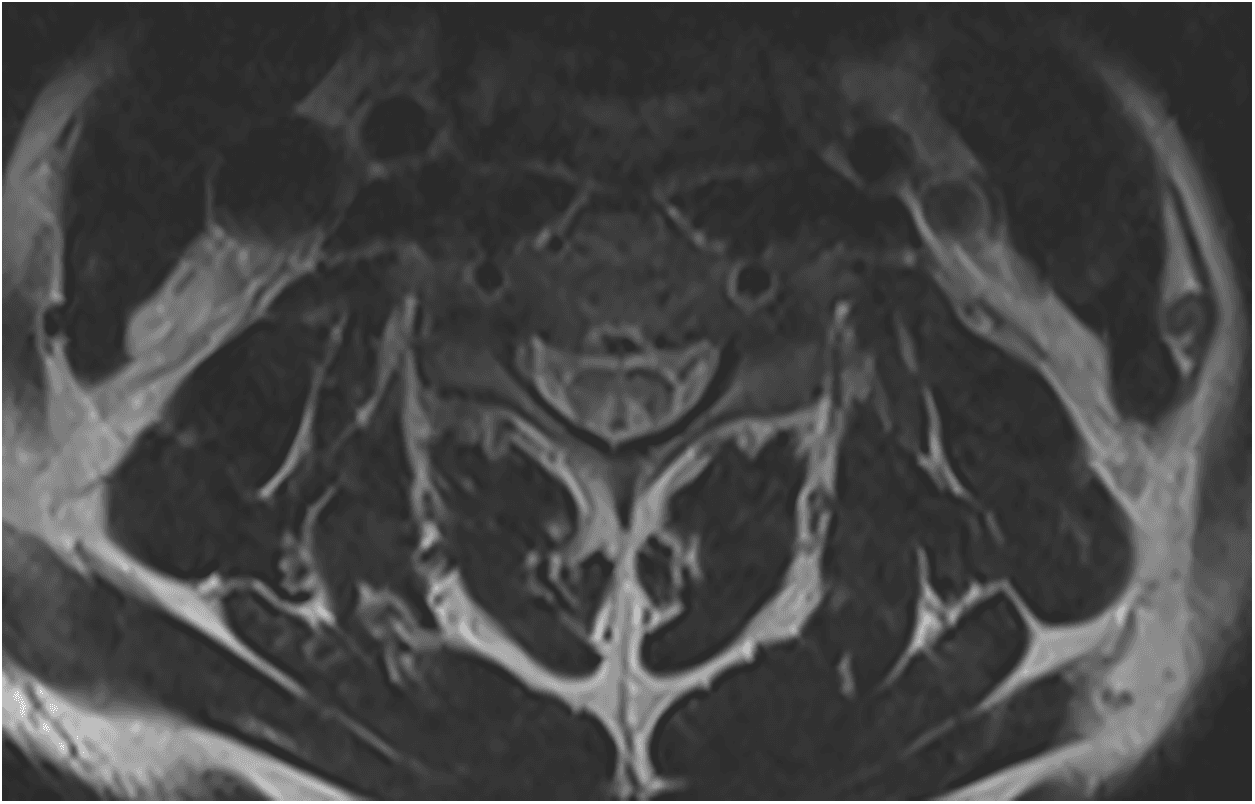
Figure 1. Magnetic resonance imaging of the cervical spine with a symmetric, bilateral, and high T2 signal in the dorsal columns, indicated by the characteristic inverted “V” or “bunny-ear” sign.
Discussion
This case highlights the neurological complications associated with vitamin B12 deficiency due to chronic nitrous oxide abuse. Nitrous oxide was first documented for use since 1844 in patients requiring dental surgeries as an anesthetic but has been largely replaced by other medications today.7 The first cases of B12 deficiency due to nitrous oxide exposure have been noted since 1978 in dentists exposed to the gas due to poorly ventilated working conditions.8 Nitrous oxide has now become increasingly popular as a recreational drug that can be easily and legally obtained at a low cost, especially in younger populations.9
B12 deficiency, a potentially reversible cause of neurological impairment, presents with a variety of symptoms, including paresthesias, peripheral neuropathy, gait disturbances, and cognitive decline.10 In severe cases, it can lead to subacute combined degeneration (SCD) of the spinal cord, as seen in this patient. This condition is characterized by demyelination of the dorsal and lateral columns, leading to impaired proprioception, vibration sensation, and ataxia, which is evident in the patient’s positive Romberg test and gait abnormalities.
While nitrous oxide abuse leading to functional B12 deficiency is the most likely diagnosis in this case, other causes of B12 deficiency and neurological dysfunction must be considered. Pernicious anemia, malabsorption syndromes (e.g., celiac disease, Crohn’s disease), or dietary insufficiency in vegetarians and vegans are common causes.10 Additionally, differential diagnoses for the patient’s symptoms could include multiple sclerosis, spinal cord compression, HIV-associated neuropathy, copper deficiency, and syphilis, all of which should be ruled out based on clinical presentation and relevant laboratory and imaging findings.10 In this case, our patient admitted to nitrous oxide use forthright, and subsequent laboratory testing and imaging pointed towards subacute combined degeneration due to B12 deficiency.
A thorough workup is essential to confirm B12 deficiency and rule out other potential causes. Initial laboratory evaluation should include serum B12, which may be falsely normal in nitrous oxide-induced deficiency. Therefore, testing for serum methylmalonic acid (MMA) and homocysteine, both of which are elevated in B12 deficiency, is crucial for confirming the diagnosis, especially in patients with inhibited abilities to absorb B12, such as those who have undergone gastric bypass surgery.11 MRI of the cervical spine is useful in identifying subacute combined degeneration, as demonstrated by the T2 signal hyperintensity in the dorsal columns in this patient’s imaging.12 However, MRI demonstrating T2 signal hyperintensity in the dorsal columns is not specific to B12 deficiency and can be seen in disorders such as copper deficiencies, HIV myelopathy, methotrexate toxicity, and vitamin E deficiencies.13
Once diagnosed, B12 deficiency can be treated with intramuscular B12 injections, which should be initiated promptly to prevent permanent neurological damage with continued ingestion of B12 and methionine supplements.14,15 General guidelines state that for treatment of B12 deficiency in those without neurological involvement, the regimen consists of 1 mg of hydroxocobalamin every other day for two weeks, then 1 mg of hydroxocobalamin injections over the course of three months.16 However, the same dose is administered in those with neurological involvement until the symptoms resolve, followed by bi-monthly injections.16 In cases of nitrous oxide-induced deficiency, counseling to discontinue use is critical as relapse is common.14 As this case demonstrates, with early intervention, neurological recovery is possible, as evidenced by the patient’s marked improvement during follow-up and his ability to return to work.
In summary, B12 deficiency should be considered in any patient presenting with neurological symptoms and a history of nitrous oxide use, with a thorough workup involving serum B12, MMA, homocysteine, and spinal imaging. Early diagnosis and treatment are essential for preventing permanent neurological damage, and early treatment can prevent irreversible outcomes.
Conclusion
This case underscores the importance of recognizing vitamin B12 deficiency as a potential complication of chronic nitrous oxide abuse, particularly in patients presenting with neurological symptoms such as peripheral neuropathy, ataxia, and cognitive changes. Nitrous oxide, commonly abused for its euphoric effects, can disrupt B12 metabolism and lead to subacute combined degeneration if left untreated. Early diagnosis through a combination of clinical evaluation, laboratory testing, and imaging is essential, as prompt initiation of B12 replacement therapy can lead to significant neurological recovery. Given the rising prevalence of nitrous oxide use, healthcare providers should remain vigilant for this diagnosis, ensuring timely intervention to prevent permanent neurological damage. Comprehensive management, including cessation counseling and follow-up, is critical for long-term recovery and relapse prevention.
Acknowledgment
We appreciate the patient’s cooperation in the data collection.
Funding Source
No financial support was provided.
Author Contributions
O.W. and T.S. were responsible for data curation. O.W. and G.C. interpreted the data and drafted the original manuscript. O.W. and T.S. made substantial contributions to revising the manuscript drafts. All authors have read the manuscript and agree with the content and data.
Data Availability Statement
The datasets used in the current study are available from the corresponding author upon reasonable request.
Ethical Statement
The article does not involve the participation of any animals. The patient gave written informed consent to the publication of this report and accompanying images.
Conflicts of Interest
The authors report no conflicts of interest in this work.
References
[1] Allan J, Cameron J, Bruno J. A systematic review of recreational nitrous oxide use: implications for policy, service delivery and individuals. Int J Environ Res Public Health. September 14, 2022;19(18):11567. doi:10.3390/ijerph191811567.
[2] van Amsterdam J, Nabben T, van den Brink W. Recreational nitrous oxide use: prevalence and risks. Regul Toxicol Pharmacol. December 2015;73(3):790–796. doi:10.1016/j.yrtph.2015.10.017.
[3] Kaar SJ, Ferris J, Waldron J, et al. Up: the rise of nitrous oxide abuse. An international survey of contemporary nitrous oxide use. J Psychopharmacol. April 2016;30(4):395–401. doi:10.1177/0269881116632375.
[4] Einsiedler M, Voulleminot P, Demuth S, et al. A rise in cases of nitrous oxide abuse: neurological complications and biological findings. J Neurol. February 2022;269(2):577–582. doi:10.1007/s00415-021-10702-7.
[5] Ankar A, Kumar A. Vitamin B12 deficiency. In: StatPearls [Internet]. Treasure Island (FL): StatPearls Publishing; 2024 Jan. Updated September 10, 2024. Available from: https://www.ncbi.nlm.nih.gov/books/NBK441923/
[6] Langan RC, Goodbred AJ. Vitamin B12 deficiency: recognition and management. Am Fam Physician. September 15, 2017;96(6):384–389.
[7] Layzer RB. Myeloneuropathy after prolonged exposure to nitrous oxide. Lancet. December 9, 1978;2(8102):1227–1230. doi:10.1016/s0140-6736(78)92101-3.
[8] Erving HW. The discoverer of anaesthesia: Dr. Horace wells of Hartford. Yale J Biol Med. May 1933;5(5):421–430.
[9] De Halleux C, Juurlink DN. Diagnosis and management of toxicity associated with the recreational use of nitrous oxide. CMAJ. August 2023;195(32):E1075–E1081. doi:10.1503/cmaj.230196.
[10] Linazi G, Abudureyimu S, Zhang J, et al. Clinical features of different stage subacute combined degeneration of the spinal cord. Medicine (Baltimore). September 16, 2022;101(37):e30420. doi:10.1097/MD.0000000000030420.
[11] Lee SM, Oh J, Chun MR, Lee SY. Methylmalonic acid and homocysteine as indicators of Vitamin B12 deficiency in patients with gastric cancer after gastrectomy. Nutrients. February 21, 2019;11(2):450. doi:10.3390/nu11020450.
[12] Gernez E, Lee GR, Niguet JP, et al. Nitrous oxide abuse: clinical outcomes, pharmacology, pharmacokinetics, toxicity and impact on metabolism. Toxics. November 28, 2023;11(12). doi:10.3390/toxics11120962.
[13] Qudsiya Z, De Jesus O. Subacute combined degeneration of the spinal cord (Archive). In: StatPearls [Internet]. Treasure Island (FL): StatPearls Publishing; 2024 Jan. Updated March 20, 2024. Available from: https://www.ncbi.nlm.nih.gov/books/NBK559316/
[14] Paris A, Lake L, Joseph A, et al. Nitrous oxide-induced subacute combined degeneration of the cord: diagnosis and treatment. Pract Neurol. June 2023;23(3):222–228. doi:10.1136/pn-2022-003631.
[15] Hvas AM, Nexo E. Diagnosis and treatment of vitamin B12 deficiency–an update. Haematologica. November 2006;91(11):1506–1512.
[16] Shipton MJ, Thachil J. Vitamin B12 deficiency—a 21st century perspective. Clin Med (Lond). April 2015;15(2):145–150. doi:10.7861/clinmedicine.15-2-145.
 |
Copyright: © 2024 Wu et al. This work is licensed under a Creative Commons Attribution 4.0 International License, which permits unrestricted use, distribution, and reproduction in any medium, provided the original work is properly cited. |