| Journal of Clinical Question. 2026; 3(4): e372 https://doi.org/10.69854/jcq.2026.0026 Advance access publication date 31 August 2026 |
 |
Review
Targeting RAS in Pancreatic Ductal Adenocarcinoma: From Molecular Breakthroughs to Phase III Clinical Validation and Beyond
En Wang 1,2,*, Ayaka Yao1,2, Maho Sasaki1,2, Ryota Tanaka3, Mohamed Hassanein4, Yushi Fujiwara1, Taigo Tokuhara1
1Department of Surgery, Asakayama General Hospital, Sakai, Japan.
2Department of Surgery, Osaka Metropolitan University Graduate School of Medicine, Osaka, Japan.
3Department of Hepato-Biliary-Pancreatic Surgery, Osaka Metropolitan University Graduate School of Medicine, Osaka, Japan.
4Faculty of Medicine, Alexandria University, Alexandria, Egypt.
*Corresponding Author: e-mail: wangen.cn@gmail.com
Submitted: July 01, 2026 Accepted: August 30, 2026
Clinical Question Box
What is the emerging role of direct RAS-targeted therapy in pancreatic ductal adenocarcinoma?
Direct RAS targeting has progressed from proof of concept to phase III clinical validation in pancreatic ductal adenocarcinoma. Daraxonrasib has demonstrated a survival benefit over chemotherapy in previously treated metastatic disease, while multiple KRAS G12D-selective inhibitors and degraders are undergoing randomized evaluation in earlier treatment settings. Molecular profiling is therefore becoming increasingly important for treatment selection, although the optimal sequencing of allele-specific, multi-selective, degradative, and combination strategies remains to be defined.
Abstract
Pancreatic ductal adenocarcinoma (PDAC) is driven by oncogenic RAS signaling in more than 90% of tumors, most commonly through KRAS mutations, yet direct pharmacologic inhibition of this dominant oncogenic driver remained elusive for decades. KRAS G12C inhibitors first established the clinical druggability of mutant KRAS, although the low prevalence of this allele limits their applicability to the broader PDAC population. The therapeutic landscape has subsequently expanded to include KRAS G12D-selective inhibitors, multi-selective active-state RAS [RAS(ON)] inhibitors, targeted protein degraders, and mechanism-based combination strategies. Most notably, daraxonrasib (RMC-6236) has provided randomized phase III validation of direct RAS inhibition. In RASolute 302, 500 patients with previously treated metastatic PDAC were randomized to receive either daraxonrasib or investigator-choice chemotherapy. In the prespecified RAS G12 population, median overall survival was 13.2 versus 6.6 months (hazard ratio, 0.40), and median progression-free survival was 7.3 versus 3.5 months (hazard ratio, 0.45). In parallel, KRAS G12D-directed inhibitors and degraders are advancing into randomized first-line and later-line studies, broadening the potential reach of RAS-targeted therapy. However, therapeutic resistance remains a major challenge and may arise through KRAS amplification, mitogen-activated protein kinase (MAPK) or phosphoinositide 3-kinase (PI3K) pathway reactivation, receptor tyrosine kinase signaling, phenotypic plasticity, and tumor-microenvironmental remodeling. These observations have prompted rational combination strategies designed to deepen pathway suppression, prevent adaptive signaling, and exploit treatment-induced vulnerabilities. This review summarizes the biological rationale and evolving clinical evidence for RAS-directed therapy in PDAC, examines emerging mechanisms of resistance and combination approaches, and discusses the molecular-testing requirements and clinical considerations that will shape its integration into routine PDAC management.
Keywords: Pancreatic ductal adenocarcinoma, PDAC, KRAS G12D, RAS(ON), daraxonrasib, targeted therapy
Introduction
Pancreatic ductal adenocarcinoma (PDAC) remains one of the most lethal solid malignancies, with mortality closely approaching incidence.1 The Global Cancer Observatory 2024 estimated 531,318 new pancreatic cancer cases and 490,786 deaths worldwide, ranking pancreatic cancer 11th in incidence but sixth in cancer mortality and accounting for 5.0% of all cancer deaths.2 Although survival has improved over time, the 5-year survival rate remains only 3% for distant-stage disease, which accounts for more than half of all diagnoses.3 This disproportionate mortality burden underscores the need for more effective systemic therapy, particularly in metastatic disease.4
Oncogenic RAS-pathway activation is a defining molecular feature of PDAC. Activating RAS mutations occur in more than 90% of tumors, predominantly as KRAS codon 12 variants.5 The historical difficulty of pharmacologically targeting RAS made KRAS a central but long-elusive therapeutic target. KRAS G12C inhibitors provided the first clinical proof that mutant KRAS is directly druggable; however, KRAS G12C occurs in only approximately 1–2% of PDACs, substantially limiting the population-level impact of this approach.6 Development has therefore shifted toward the more prevalent KRAS G12D allele, multi-selective RAS(ON) inhibition, targeted protein degradation, and rational combinations.7,8 The phase III RASolute 302 trial has now moved this field beyond proof of concept by demonstrating a survival benefit with daraxonrasib over investigator-choice chemotherapy in previously treated metastatic PDAC.9
Accordingly, the central clinical question is no longer whether RAS can be targeted, but how different RAS-directed strategies should be deployed across molecular subgroups and treatment settings. The emerging therapeutic spectrum spans allele-specific inhibition, active-state multi-selective blockade, and targeted degradation, with distinct implications for molecular selection, depth and breadth of pathway suppression, and resistance.10,11 This review examines the pharmacologic basis and clinical evidence for direct RAS/KRAS targeting in PDAC, together with combination strategies, resistance mechanisms, and translational requirements for integration into routine care.
RAS(ON)/RAS(OFF) Pharmacology
RAS proteins function as molecular switches that cycle between inactive guanosine diphosphate (GDP)-bound and active guanosine triphosphate (GTP)-bound states. Following receptor tyrosine kinase (RTK) activation, son of sevenless (SOS)-family guanine nucleotide exchange factors facilitate nucleotide exchange and promote GTP loading, whereas GTPase-activating proteins (GAPs) accelerate GTP hydrolysis, returning RAS to its inactive GDP-bound state (Fig. 1).12 Oncogenic KRAS substitutions, particularly at codon 12, impair intrinsic and GTPase-activating protein–stimulated GTP hydrolysis, shifting KRAS toward the active GTP-bound state and sustaining downstream signaling through major effector pathways, including RAF–mitogen-activated protein kinase kinase (MEK)–extracellular signal-regulated kinase (ERK) and phosphoinositide 3-kinase (PI3K)–protein kinase B (AKT)–mechanistic target of rapamycin (mTOR).13 In PDAC, sustained RAS signaling promotes proliferation, survival, metabolic adaptation, stromal remodeling, and immune evasion. KRAS G12D, G12V, and G12R are the predominant variants, whereas G12C accounts for only a small minority of pancreatic cancers.14,15
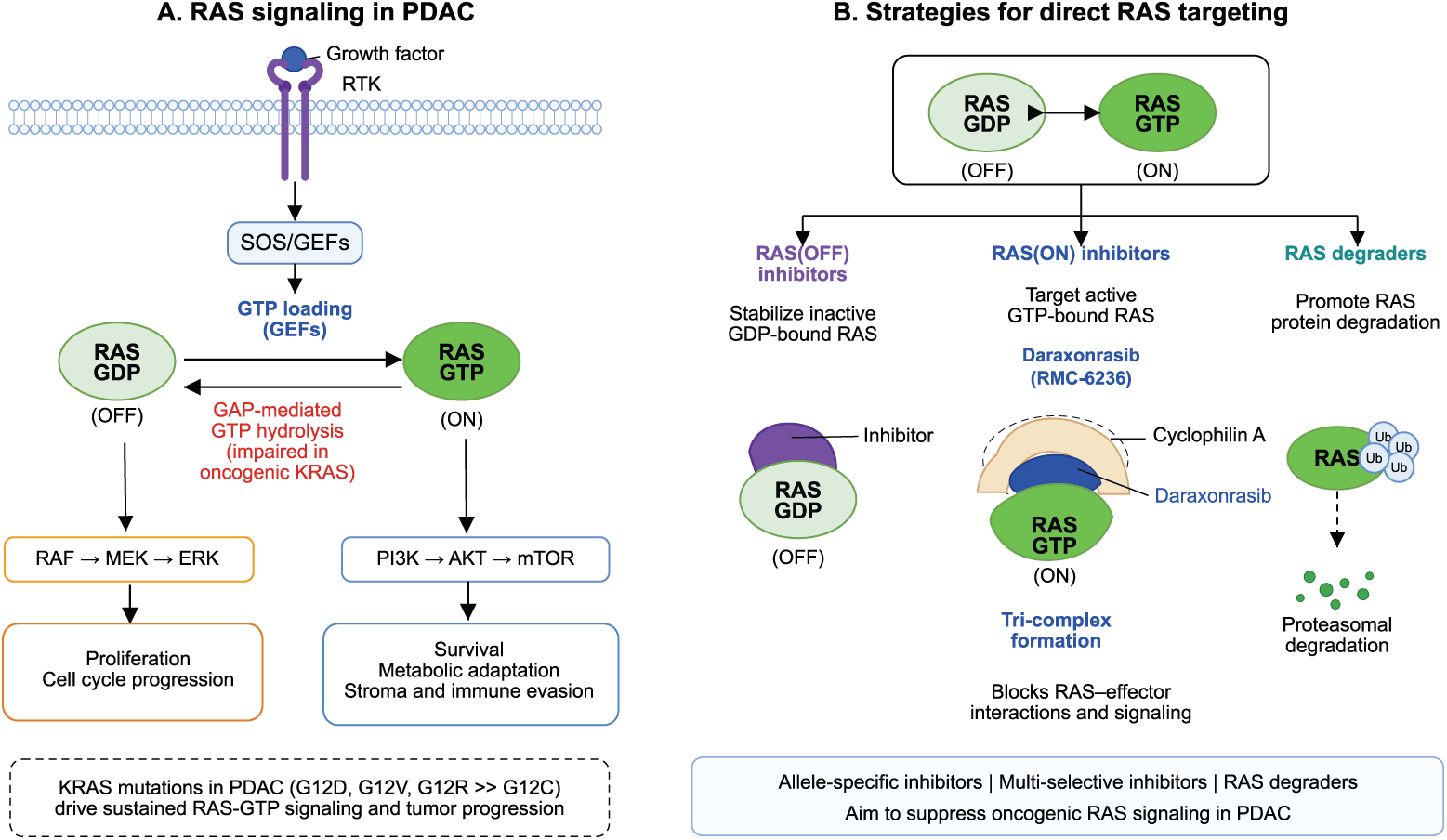
Figure 1. RAS signaling and direct targeting strategies in PDAC.
KRAS was historically considered “undruggable” because of its high affinity for guanine nucleotides, limited druggable surface pockets, conformational dynamics of the switch regions, and adaptive signaling networks.16 The development of covalent KRAS G12C inhibitors established that mutation- and conformation-dependent pockets could nevertheless be pharmacologically exploited.17 However, common PDAC-associated variants such as G12D lack the reactive cysteine required for G12C-directed covalent inhibition, prompting the development of alternative allele-specific inhibitors, multi-selective RAS inhibitors, and targeted degraders.18
These approaches differ fundamentally in how they engage the RAS signaling cycle. RAS(OFF) inhibitors preferentially bind the inactive GDP-bound state and therefore depend on nucleotide cycling to generate a drug-accessible RAS pool.19 Adaptive activation of receptor tyrosine kinase (RTK)–SOS signaling can increase RAS–GTP loading and reactivate mitogen-activated protein kinase (MAPK) signaling, in part through compensatory activation of wild-type RAS isoforms. In contrast, RAS(ON) inhibitors directly engage signaling-competent, GTP-bound RAS.20 Daraxonrasib (RMC-6236) is a multi-selective RAS(ON) inhibitor that forms a noncovalent tri-complex with RAS–GTP and cyclophilin A.21 This interaction creates a composite, drug-induced binding interface involving the RAS switch regions and sterically blocks RAS–effector interactions, thereby suppressing signaling from multiple mutant and wild-type RAS proteins. Such multi-selective inhibition may be particularly relevant in PDAC by reducing dependence on a single KRAS allele and potentially limiting bypass signaling through other RAS proteins.
Targeted protein degradation represents a mechanistically distinct strategy. Rather than relying on sustained target occupancy, bifunctional degraders recruit an E3 ubiquitin ligase to mutant KRAS, promoting formation of a KRAS–degrader–E3 ligase ternary complex, ubiquitination of KRAS, and subsequent proteasomal degradation.22 For example, the KRAS G12D-selective degrader ASP3082 recruits von Hippel–Lindau (VHL) and removes KRAS G12D protein, producing sustained suppression of downstream ERK, AKT, and S6 signaling in preclinical PDAC models.23 This event-driven mechanism may provide more durable pathway suppression than conventional occupancy-based inhibition, although its clinical advantages remain to be established.
Evolution of Direct RAS/KRAS-Targeted Therapies
Clinical validation of direct KRAS inhibition in PDAC began with the rare KRAS G12C allele. Sotorasib and adagrasib produced objective responses in previously treated KRAS G12C-mutant PDAC, establishing proof of druggability.24,25 However, because KRAS G12C accounts for only approximately 1–2% of pancreatic cancers, development rapidly shifted toward the much more prevalent G12D allele.5
KRAS G12D has become the major allele-specific focus. MRTX1133 provided preclinical proof of principle for potent, selective, noncovalent G12D inhibition and entered first-in-human development, although that program did not progress to phase II.26,27 The current pipeline is mechanistically diverse: zoldonrasib is a G12D-selective RAS(ON) inhibitor, whereas GFH375/VS-7375 and INCB161734 engage both active and inactive G12D states.28,29 HRS-4642 uses intravenous liposomal delivery to enhance tumor exposure and has shown clinical activity with gemcitabine/nab-paclitaxel.30 Several of these agents have already entered randomized phase III evaluation.
Targeted protein degradation provides a mechanistically distinct G12D strategy. Setidegrasib (ASP3082) recruits an E3 ubiquitin ligase to KRAS G12D, promoting proteasomal elimination rather than continuous inhibitor occupancy. First-in-human data demonstrated target degradation and antitumor activity in KRAS G12D-mutant solid tumors, including PDAC, and setidegrasib has progressed to randomized phase III evaluation with modified fluorouracil, leucovorin, irinotecan, and oxaliplatin (mFOLFIRINOX) or liposomal irinotecan, oxaliplatin, leucovorin, and fluorouracil (NALIRIFOX) as first-line therapy.31,32 This approach extends direct KRAS therapy from state-selective inhibition to event-driven elimination of the mutant protein.
Multi-selective RAS(ON) inhibition represents a broader strategy. Daraxonrasib targets signaling-competent RAS–GTP across multiple oncogenic variants and wild-type RAS through a cyclophilin A-dependent tri-complex mechanism.21 Its phase III success in RASolute 302 established the first randomized survival benefit for direct RAS inhibition in previously treated metastatic PDAC.9 Daraxonrasib is now being evaluated in first-line metastatic and post-resection settings. Collectively, the field has progressed from rare-allele inhibition to common-allele targeting, targeted degradation, and broader RAS blockade; the key issue is now how best to match the breadth and durability of RAS suppression to PDAC biology (Fig. 2).
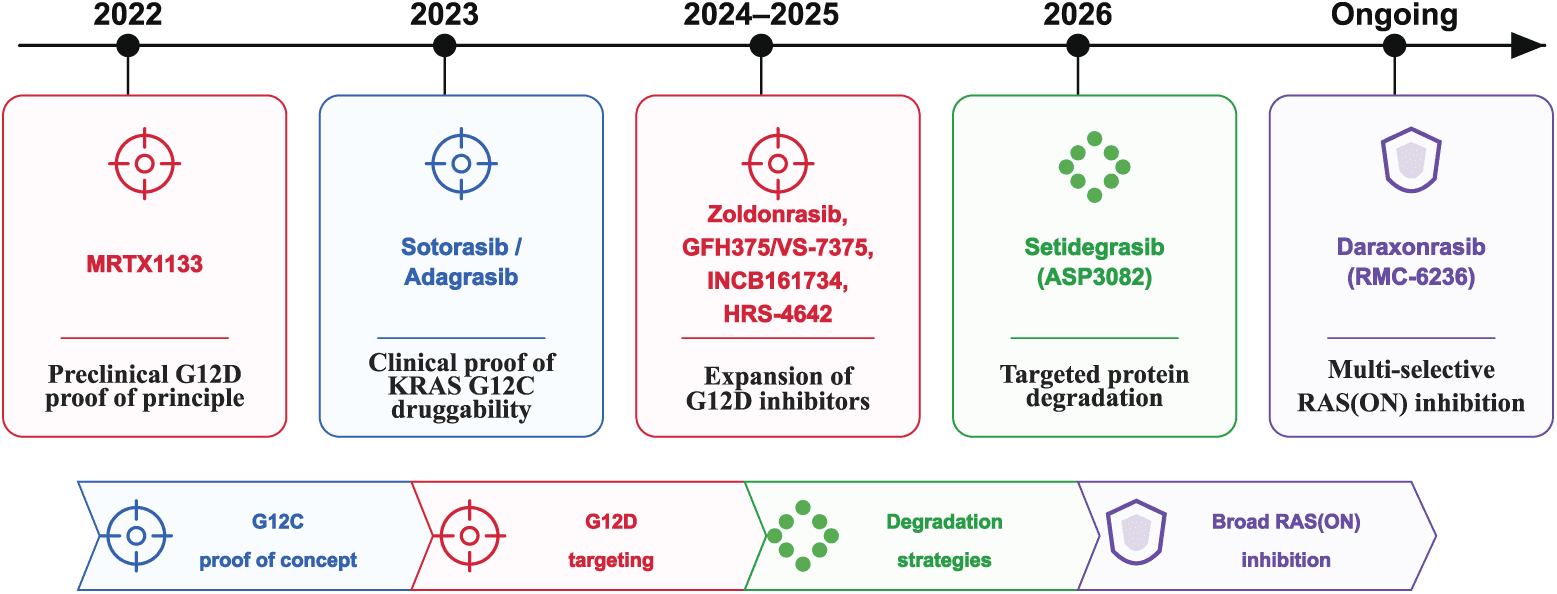
Figure 2. Development timeline of direct RAS-targeted therapeutic strategies in PDAC.
Clinical Evidence of RAS/KRAS-Targeted Therapy in PDAC
Clinical evidence for direct RAS targeting now ranges from early-phase, single-arm cohorts and conference reports to randomized phase III trials. Because studies differ in line of therapy, molecular eligibility, prior treatment, dose, evaluable population, response confirmation, and follow-up, cross-trial numerical comparisons are potentially misleading. Objective response rate (ORR) can identify antitumor activity but should not be treated as a surrogate for progression-free survival (PFS) or overall survival (OS) across agents or settings.33 Randomized time-to-event evidence should therefore be interpreted separately from preliminary single-arm signals (Table 1).
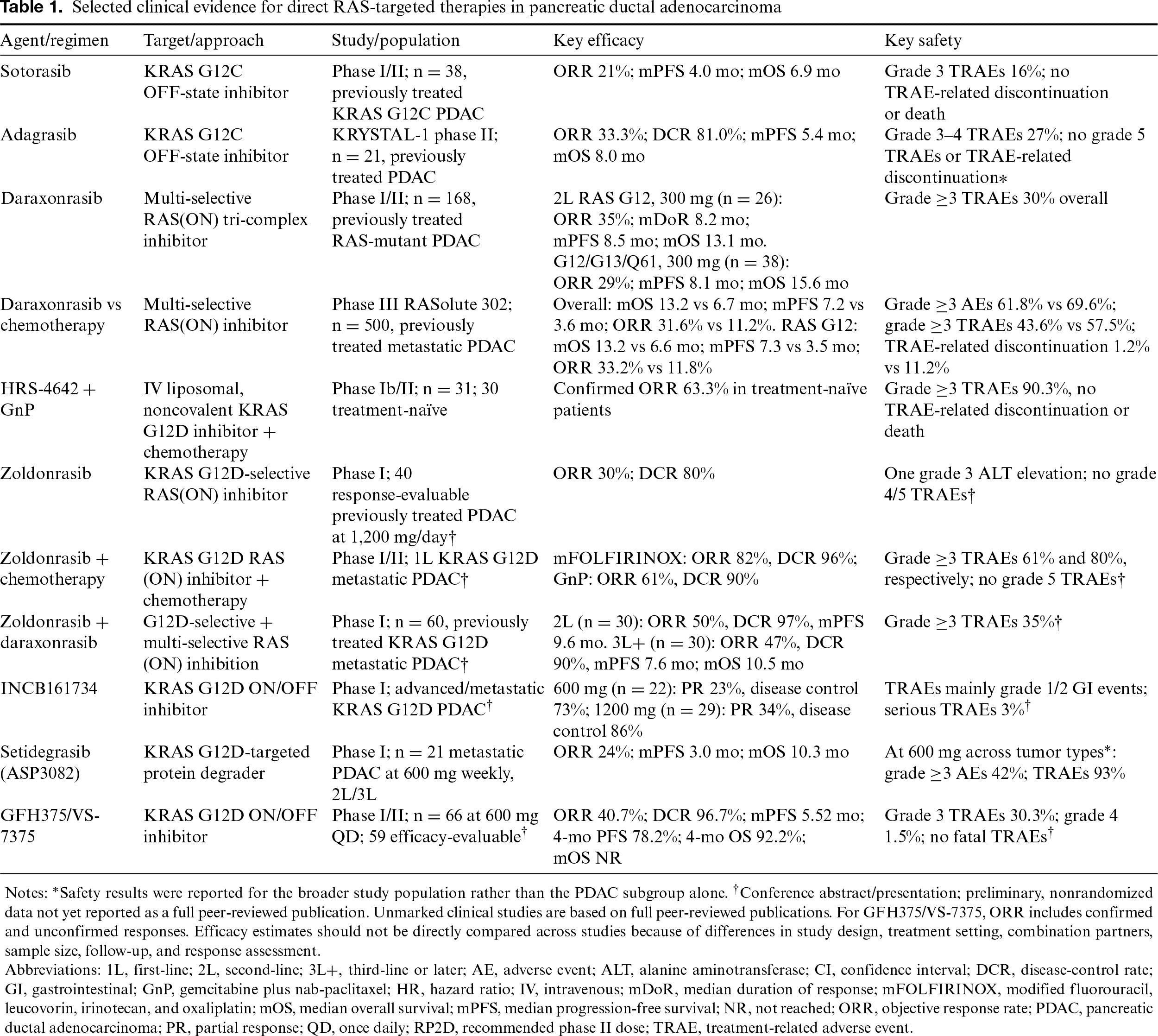
In KRAS G12C-mutant PDAC, sotorasib and adagrasib provided the first clinical proof of principle that direct KRAS inhibition could induce tumor regression. In the CodeBreaK 100 cohort, sotorasib produced a confirmed ORR of 21% among 38 previously treated patients, with median PFS and OS of 4.0 and 6.9 months, respectively.24 Adagrasib subsequently demonstrated a confirmed ORR of 33.3% among 21 patients with PDAC, with median PFS of 5.4 months and median OS of 8.0 months.25 These studies established the clinical tractability of direct KRAS inhibition in PDAC, although their population-level applicability is limited by the rarity of KRAS G12C in this disease.
Daraxonrasib generated the most mature early-phase evidence for direct RAS inhibition in PDAC. In the phase I/II study, 168 patients with previously treated RAS-mutated PDAC received doses up to 300 mg once daily.34 Among 26 second-line patients with RAS G12 mutations treated at the selected 300-mg dose, the objective response rate (ORR) was 35%, median duration of response was 8.2 months, median progression-free survival (PFS) was 8.5 months, and median overall survival (OS) was 13.1 months; grade ≥3 treatment-related adverse events occurred in approximately 30%.35 These findings demonstrated clinically meaningful and durable antitumor activity with a manageable safety profile and supported randomized evaluation of the 300-mg once-daily regimen.
Randomized validation occurred in the international, open-label, phase III RASolute 302 trial, which assigned 500 patients with previously treated metastatic PDAC to either daraxonrasib or investigator-choice chemotherapy.9 In the prespecified RAS G12 population, both primary endpoints were significantly improved with daraxonrasib: median OS was 13.2 versus 6.6 months (hazard ratio [HR], 0.40), and median PFS was 7.3 versus 3.5 months (HR, 0.45).9 The ORR was also higher with daraxonrasib (33.2% vs 11.8%). These benefits were accompanied by a more favorable treatment-discontinuation profile relative to chemotherapy, further supporting the clinical relevance of direct RAS inhibition. However, because 91.8% of randomized patients harbored RAS G12 mutations, the positive overall-population analysis should not be interpreted as establishing equivalent efficacy in the small subgroup with non-G12 or no identified RAS alterations. RASolute 302 therefore provides the first randomized phase III evidence that multi-selective RAS inhibition can translate early-phase response activity into a substantial survival benefit in previously treated metastatic PDAC.
Clinical development of KRAS G12D-directed therapy has also accelerated, although most evidence remains nonrandomized. Initial phase I data with zoldonrasib (RMC-9805), a G12D-selective RAS(ON) inhibitor, showed an ORR of approximately 30% and a disease-control rate of 80% in previously treated KRAS G12D-mutant PDAC.35 More recent combination data presented at the 2026 European Society for Medical Oncology (ESMO) Gastrointestinal Cancers Congress showed ORRs of 82% with zoldonrasib plus modified FOLFIRINOX and 61% with zoldonrasib plus gemcitabine/nab-paclitaxel in the first-line setting, with disease-control rates of 96% and 90%, respectively.36 In a separate study of zoldonrasib plus daraxonrasib, the second-line cohort (n = 30) had an ORR of 50% and a median PFS of 9.6 months, whereas the third-line-or-later cohort (n = 30) had an ORR of 47% and a median PFS of 7.6 months.37 These combination results are clinically encouraging but remain preliminary, nonrandomized, and unsuitable for cross-trial comparison with phase III data.
Other G12D-selective inhibitors have also demonstrated early clinical activity. Updated data for GFH375/VS-7375, which targets both the GDP- and GTP-bound states of KRAS G12D, showed an ORR of 41%, a disease-control rate of 97%, and a 3-month PFS rate of 83% in previously treated PDAC, although follow-up remained relatively short.38 Similarly, INCB161734 produced an ORR of 37% and a disease-control rate of 78% among 41 evaluable patients treated with the recommended 1,200-mg once-daily dose; duration of response and PFS estimates remained immature at the time of the reported analysis.39 These findings further establish the pharmacologic tractability of KRAS G12D but should remain classified as early-phase evidence pending mature survival data and randomized confirmation.
HRS-4642 provides peer-reviewed evidence for combining direct G12D inhibition with chemotherapy. In a phase Ib/II study, 31 patients with advanced KRAS G12D-mutant PDAC were treated with HRS-4642 plus gemcitabine and nab-paclitaxel, including 30 treatment-naïve patients evaluated in the phase II population. At a median follow-up of 12.3 months, the confirmed ORR among these 30 patients was 63.3% (95% confidence interval [CI], 43.9–80.1).30 Grade ≥3 treatment-related adverse events occurred in 90.3% of patients and were predominantly hematologic toxicities consistent with the chemotherapy backbone; no treatment-related adverse event resulted in treatment discontinuation or death. Although the response rate is notable, the small, single-arm cohort and the use of concomitant chemotherapy preclude attribution of the observed efficacy to HRS-4642 alone.
Targeted protein degradation has also generated clinical proof of concept. In the first-in-human study of setidegrasib (ASP3082), 21 patients with metastatic KRAS G12D-mutant PDAC received the selected 600-mg weekly dose. The ORR was 24%, with a median PFS of 3.0 months and a median OS of 10.3 months.31 These data demonstrate that pharmacologic degradation of mutant KRAS can translate into measurable clinical antitumor activity, although the magnitude and durability of benefit require confirmation in larger, randomized studies.
KRAS G12D-Directed Therapy
KRAS G12D is the most common KRAS substitution in PDAC, occurring in approximately 40% of cases, and therefore represents a substantially broader therapeutic opportunity than KRAS G12C.31 The G12D pipeline is mechanistically diverse, encompassing active-state RAS(ON) inhibition, dual ON/OFF-state inhibition, noncovalent small-molecule inhibition, and targeted protein degradation. These approaches differ in how they engage or eliminate mutant KRAS and may consequently have distinct requirements for target exposure, combination therapy, toxicity management, and strategies to prevent or overcome adaptive resistance.
Early clinical studies have demonstrated antitumor activity with zoldonrasib, HRS-4642, GFH375/VS-7375, INCB161734, and setidegrasib.35,36,40–42 However, the available evidence remains heterogeneous with respect to trial design, treatment setting, dose, combination partner, and duration of follow-up, precluding meaningful cross-trial comparisons of response rates. In particular, responses observed with first-line chemotherapy combinations cannot be attributed to the KRAS-directed agent alone, whereas later-line monotherapy cohorts remain relatively small. Nevertheless, the consistency of early activity across mechanistically distinct agents provides clinical evidence that KRAS G12D is a tractable therapeutic target in PDAC.
Development has now progressed rapidly into randomized phase III testing (Table 2). Zoldonrasib, INCB161734, setidegrasib, and HRS-4642 are being evaluated in combination with chemotherapy in previously untreated metastatic disease, testing whether G12D-directed therapy can deepen and prolong the benefit of established first-line regimens.28,29,43–46 In parallel, GFH375 and DN022150 are being compared directly with investigator-choice chemotherapy after prior treatment, addressing whether selective G12D inhibition can replace cytotoxic therapy in the later-line setting. This parallel development strategy should help define not only whether KRAS G12D targeting improves outcomes but also where it should be positioned in the treatment sequence.
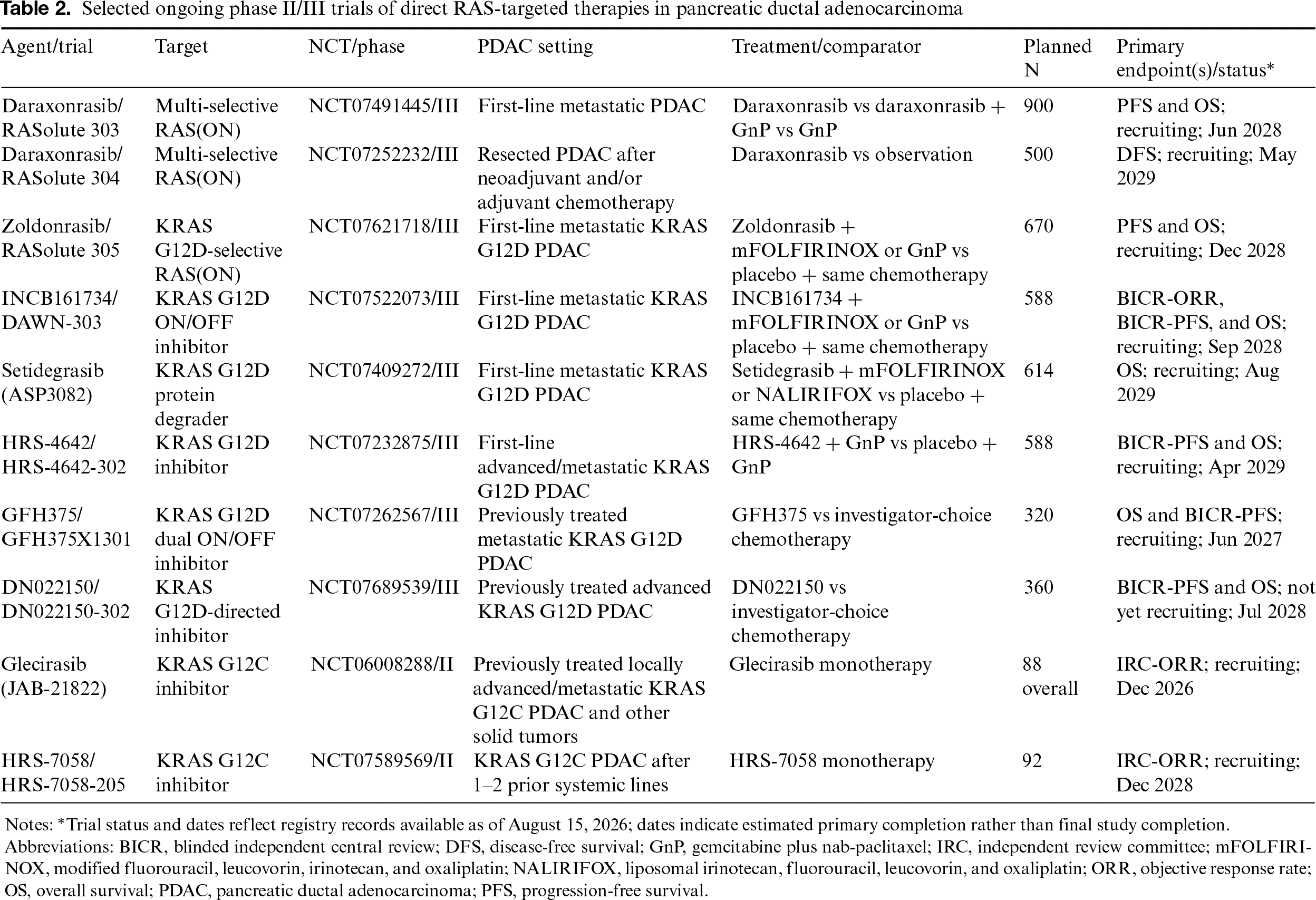
Accordingly, the central question is no longer whether KRAS G12D is pharmacologically druggable, but which modality provides the most favorable balance of efficacy, durability, tolerability, and resistance control in each clinical setting. Mature progression-free survival and overall survival data, together with molecular analyses of acquired resistance, will be required to establish the relative clinical roles of these approaches; early objective response rates alone are unlikely to define a therapeutic hierarchy.
Resistance to Direct RAS-Targeted Therapy
Resistance is emerging as a major determinant of the durability of direct RAS-targeted therapy in PDAC and appears to be both heterogeneous and inhibitor dependent. In KRAS G12C-mutant PDAC treated with sotorasib or adagrasib, acquired alterations have included KRAS and PIK3CA mutations, as well as amplification of KRAS G12C, MYC, MET, epidermal growth factor receptor (EGFR), and cyclin-dependent kinase 6 (CDK6).47 More recent clinical data with daraxonrasib provide a distinct resistance profile. Among 44 patients with paired pretreatment and end-of-treatment circulating tumor DNA (ctDNA), treatment-emergent alterations in RAS-related signaling were detected in 59%, including mutant KRAS amplification in 36%, MAPK-pathway alterations in 25%, receptor tyrosine kinase alterations in 9%, and PI3K-pathway alterations in 9%.48 Notably, no acquired secondary KRAS mutations were identified, suggesting that resistance to multi-selective RAS(ON) inhibition may rely more heavily on increased RAS dosage and pathway reactivation than on the secondary target mutations observed with some mutant-selective KRAS inhibitors.48
Nongenetic resistance adds further complexity. Preclinical PDAC models exposed to the KRAS G12D inhibitor MRTX1133 have linked resistance to PI3K–AKT–mTOR activation, epithelial-to-mesenchymal transition, genomic amplification of Kras, Yap1, Myc, and Cdk6, and co-evolving transcriptional programs.47 However, cell-state effects are context dependent rather than uniformly mesenchymal. Independent lineage-tracing studies have demonstrated that KRAS inhibition can rapidly enrich a relatively resistant classical epithelial state, which subsequently serves as a reservoir for tumor relapse.49 Together, these findings suggest that phenotypic plasticity, rather than a single resistant transcriptional state, enables PDAC cells to adapt to sustained RAS suppression.48
Recent work has also identified a tumor-microenvironmental resistance mechanism. In PDAC models, KRAS G12D inhibition initially increased immune infiltration, whereas prolonged treatment was followed by loss of this immune-permissive state and the emergence of cyclin-dependent kinase 8 (CDK8)-mediated resistance.50 CDK8 promoted C–X–C motif chemokine ligand 2 (CXCL2) secretion, suppressed FAS expression, and remodeled the tumor microenvironment toward immune evasion. Importantly, increased CDK8 expression was also observed in patient-derived xenografts resistant to both daraxonrasib and zoldonrasib, suggesting a potentially shared resistance node across allele-specific and multi-selective RAS(ON) inhibition.50 Pharmacologic inhibition of CDK8 or C-X-C motif chemokine receptor 2 (CXCR2) delayed resistance in preclinical models, and CDK8 inhibition restored sensitivity to cytotoxic T-lymphocyte-associated protein 4 (CTLA-4) blockade in established resistant tumors; these strategies, however, remain preclinical.50
A clinically useful framework is to distinguish target-level resistance (for example, mutant KRAS amplification or secondary KRAS alterations), pathway reactivation or bypass through RTK–MAPK or PI3K signaling, and nongenetic escape mediated by cell-state plasticity or the tumor microenvironment (Fig. 3).48,50 These mechanisms may coexist within the same patient. ctDNA is well suited to detecting emerging genomic alterations but cannot fully characterize transcriptional state or microenvironmental remodeling. Therefore, translational studies should, when feasible, complement longitudinal ctDNA with paired tissue analyses incorporating RNA, protein, or spatial profiling to distinguish genomic pathway reactivation from phenotypic or microenvironmental adaptation.48,50
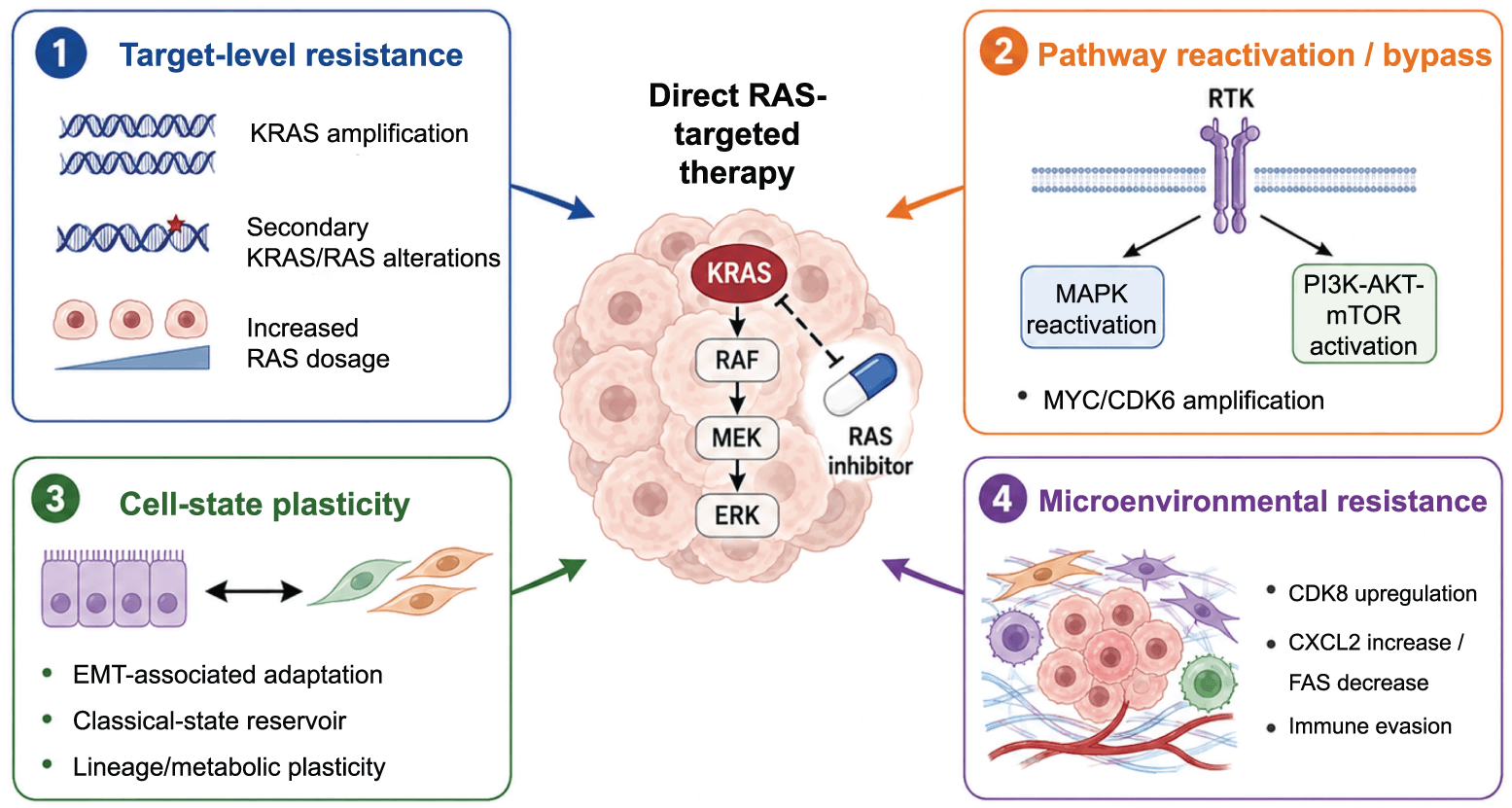
Figure 3. Resistance to direct RAS-targeted therapy in PDAC.
The heterogeneity of resistance also argues against a universal salvage combination. In daraxonrasib-resistant preclinical models, resistance mechanisms informed combinations targeting receptor tyrosine kinases, DNA-damage response pathways, or complementary RAS dependencies, including combined treatment with daraxonrasib and zoldonrasib.48 These observations favor a resistance-informed approach rather than empiric pathway intensification. Future trials should incorporate longitudinal molecular sampling and prospectively test whether resistance biomarkers can guide combination or sequential therapy. Ultimately, defining the mechanisms present before treatment, during response, and at progression may be as important as identifying the initial RAS mutation itself for optimizing the durability of RAS-directed therapy.
Combination Strategies
Combination therapy is likely to be central to improving the depth and durability of RAS-targeted therapy in PDAC. Adaptive pathway reactivation, increased RAS signaling, parallel survival dependencies, and tumor-microenvironmental remodeling can all limit sustained responses to monotherapy. Recent resistance studies therefore favor a mechanism-driven approach in which combination partners are selected to suppress recurrent RAS signaling, exploit vulnerabilities induced by RAS inhibition, or intercept specific bypass mechanisms, rather than simply adding nonspecific cytotoxicity.48
Chemotherapy combinations are the most clinically advanced strategy. Early studies of HRS-4642 plus gemcitabine/nab-paclitaxel and zoldonrasib plus either mFOLFIRINOX or gemcitabine/nab-paclitaxel have shown encouraging first-line activity, but their single-arm designs prevent isolation of the targeted agents’ contributions.30 Multiple randomized phase III programs are therefore evaluating RAS- or KRAS-directed agents with contemporary chemotherapy backbones, including daraxonrasib, zoldonrasib, INCB161734, setidegrasib, and HRS-4642. These studies will determine whether targeted therapy should augment, rather than replace, first-line cytotoxic therapy.
Paired ctDNA analyses from patients progressing on daraxonrasib identified mutant KRAS amplification and alterations in RTK, MAPK, and PI3K signaling as recurrent mechanisms of acquired resistance, with selected mechanisms subsequently validated in preclinical PDAC models.51 These findings supported combinations with RTK-directed therapies, DNA-damage response inhibitors, and intensified direct RAS blockade. Daraxonrasib increased surface human epidermal growth factor receptor 2 (HER2) expression in some PDAC models and showed enhanced activity with trastuzumab deruxtecan, whereas EGFR/MET targeting with amivantamab prolonged tumor control in RTK-dependent models.48 The combination of daraxonrasib and zoldonrasib produced deeper and more durable RAS-pathway suppression preclinically and has shown preliminary clinical activity in previously treated KRAS G12D-mutant PDAC.37 Together, these observations favor biomarker-directed combinations over a universal vertical-pathway doublet.
RAS inhibition may also create therapeutic vulnerabilities outside the canonical MAPK pathway. KRAS G12D inhibition has been shown to suppress homologous-recombination repair proteins, including BRCA1, RAD51, and RPA32, thereby sensitizing PDAC models to poly(ADP-ribose) polymerase (PARP) inhibition. MRTX1133 plus olaparib produced synergistic activity and durable tumor regression, including in models resistant to KRAS G12D inhibition.52 Separately, daraxonrasib-resistant models with KRAS amplification demonstrated increased dependence on DNA-damage response pathways, providing additional rationale for targeting the ataxia telangiectasia and Rad3-related protein (ATR)–checkpoint kinase 1 (CHK1)–WEE1 axis.48 These approaches remain preclinical but illustrate how RAS suppression may generate actionable collateral vulnerabilities.
Immunotherapy combinations have gained a more specific mechanistic rationale. KRAS inhibition can transiently increase T-cell infiltration, but this immune-permissive state may not persist. Preclinical studies showed that MRTX1133 or daraxonrasib sensitized PDAC to CTLA-4 blockade, with regulatory T-cell reprogramming, reversal of cluster of differentiation 8 (CD8)-positive T-cell exhaustion, and formation of functional tertiary lymphoid structures; comparable benefit was not observed with programmed cell death protein 1 (PD-1), T-cell immunoglobulin and mucin domain-containing 3 (TIM-3), lymphocyte activation gene 3 (LAG-3), V-domain immunoglobulin suppressor of T-cell activation (VISTA), or tumor necrosis factor receptor superfamily member 9 (4-1BB/CD137)-directed combinations in the same models.53 CDK8-mediated CXCL2 induction and FAS suppression also contributed to immune escape during prolonged KRAS inhibition, whereas CDK8 inhibition restored antitumor activity and enhanced CTLA-4 blockade in resistant models.50 These data argue for mechanism- and context-specific immunotherapy combinations rather than empiric checkpoint blockade. Related clinical experience in PDAC also supports targeting the immunosuppressive microenvironment: a phase I/II neoadjuvant study of the CCR2/5 inhibitor BMS-813160 plus nivolumab and gemcitabine/nab-paclitaxel reported reduced intratumoral monocytes/macrophages and enhanced T-cell activation, although larger studies are needed to define clinical benefit.54
Future Directions
Clinical implementation of RAS-directed therapy will require reliable and increasingly comprehensive molecular profiling. Tissue-based next-generation sequencing remains the principal approach, while ctDNA can complement tissue testing when material is limited, rapid genotyping is needed, or serial monitoring is desirable.55,56 Plasma and tissue assays are not interchangeable in PDAC, however, because low ctDNA shedding can reduce the sensitivity of a negative plasma result. As therapy expands from allele-specific inhibitors to broader RAS-directed strategies, clinically relevant profiling may need to extend beyond KRAS variant identification to include co-mutations, allele dosage, clonality, and competing oncogenic drivers. Serial ctDNA may also provide pharmacodynamic and resistance information, but prospective validation is required before molecular clearance, persistence, or re-emergence can routinely guide treatment decisions.48 Accordingly, baseline molecular profiling used to identify actionable alterations for treatment selection should be distinguished from serial ctDNA monitoring of treatment response or emerging resistance, which remains investigational and is not currently established as a standard-of-care decision tool in PDAC.
The therapeutic landscape is simultaneously moving from later-line proof-of-concept studies to randomized testing across the disease continuum (Table 2). Daraxonrasib currently provides the most mature phase III evidence in previously treated metastatic PDAC.9 Ongoing studies are evaluating first-line combinations, later-line targeted monotherapy, and post-resection therapy. Their results will determine whether RAS-directed treatment is best used to augment chemotherapy, replace cytotoxic therapy after progression, or suppress residual disease after curative-intent treatment. Importantly, early-phase ORR should not be assumed to predict survival benefit, and comparisons across strategies must account for toxicity, treatment exposure, molecular selection, and resistance biology.
Future trials should therefore prioritize biomarker-rich randomized designs rather than efficacy endpoints alone. Prespecified baseline and progression tissue, serial ctDNA, pharmacodynamic measures of RAS-MAPK suppression, and standardized post-progression treatment data will be essential for linking clinical outcome to mechanism.56 Such datasets may clarify whether early molecular response predicts durable benefit, whether resistance differs by drug class, and whether sequential use of allele-specific and multi-selective RAS inhibitors is biologically rational.57,58 The central challenge is to convert an expanding portfolio of active agents into a durable, evidence-based, and clinically implementable treatment algorithm.
Conclusions
Direct RAS targeting in PDAC has progressed from proof of concept to phase III validation, with daraxonrasib demonstrating a survival benefit in previously treated metastatic disease and multiple G12D-selective inhibitors and degraders advancing through randomized trials. The remaining challenge is to define optimal sequencing and combination strategies across molecular and clinical settings. Biomarker-driven trials incorporating mature survival endpoints and longitudinal tissue and circulating tumor DNA profiling will be essential to translate RAS druggability into durable, molecularly stratified treatment algorithms for PDAC.
Acknowledgment
Not applicable.
Funding
This work received no specific funding.
Author Contributions
E.W. conceived the review, reviewed and interpreted the relevant literature, and drafted the manuscript. A.Y., M.S., R.T., M.H., Y.F., and T.T. reviewed the relevant literature and critically revised the manuscript for important intellectual content. All authors reviewed and approved the final version of the manuscript. E.W. accepts primary responsibility for the accuracy and integrity of the work.
Data Availability Statement
No data were generated or analyzed in this study.
Generative AI Declaration
Generative artificial intelligence was used solely for language editing and proofreading. The author reviewed and approved all changes and remains fully responsible for the manuscript content.
Ethics Statement
Not applicable.
Conflict of Interest
The author declares no conflicts of interest.
References
[1] Siegel RL, Kratzer TB, Wagle NS, Sung H, Jemal A. Cancer statistics, 2026. CA Cancer J Clin. 2026;76(1):e70043. doi:10.3322/caac.70043.
[2] Sung H, Filho AM, Laversanne M. Global cancer statistics 2024: GLOBOCAN estimates of incidence and mortality worldwide for 34 cancers in 186 countries. CA Cancer J Clin. 2026;76(4):e70090. doi:10.3322/caac.70090.
[3] Rahib L, Coffin T, Kenner B. Factors driving pancreatic cancer survival rates. Pancreas. July 1, 2025;54(6):e530–e536. doi:10.1097/mpa.0000000000002489.
[4] National Cancer Institute. Cancer Stat Facts: Pancreatic Cancer. Surveillance, Epidemiology, and End Results Program. Bethesda, MD: National Cancer Institute; 2026. Accessed August 25, 2026. https://seer.cancer.gov/statfacts/html/pancreas.html.
[5] Varghese AM, Perry MA, Chou JF, et al. Clinicogenomic landscape of pancreatic adenocarcinoma identifies KRAS mutant dosage as prognostic of overall survival. Nat Med. 2025;31(2):466–477. doi:10.1038/s41591-024-03362-3.
[6] Hong DS, Fakih MG, Strickler JH, et al. KRAS(G12C) inhibition with sotorasib in advanced solid tumors. N Engl J Med. September 24, 2020;383(13):1207–1217. doi:10.1056/NEJMoa1917239.
[7] Stickler S, Rath B, Hamilton G. Targeting KRAS in pancreatic cancer. Oncol Res. 2024;32(5):799–805. doi:10.32604/or.2024.045356.
[8] Wang X, Allen S, Blake JF, et al. Identification of MRTX1133, a noncovalent, potent, and selective KRAS(G12D) inhibitor. J Med Chem. February 24, 2022;65(4):3123–3133. doi:10.1021/acs.jmedchem.1c01688.
[9] O’Reilly EM, Wainberg ZA, Hendifar AE, et al. Daraxonrasib or chemotherapy in previously treated metastatic pancreatic cancer. N Engl J Med. 2026;395(4):325–337. doi:10.1056/NEJMoa2605555.
[10] Hu ZI, O’Reilly EM. Therapeutic developments in pancreatic cancer. Nat Rev Gastroenterol Hepatol. 2024;21(1):7–24. doi:10.1038/s41575-023-00840-w.
[11] Conroy T, Ducreux M, Committee EG. ESMO clinical practice guideline express update on the management of metastatic pancreatic cancer. ESMO Open. 2025;10:104528. doi:10.1016/j.esmoop.2025.104528.
[12] Boriack-Sjodin PA, Margarit SM, Bar-Sagi D, Kuriyan J. The structural basis of the activation of Ras by Sos. Nature. July 1, 1998;394(6691):337–343. doi:10.1038/28548.
[13] Choucair K, Imtiaz H, Uddin MH, et al. Targeting KRAS mutations: orchestrating cancer evolution and therapeutic challenges. Signal Transduct Target Ther. November 28, 2025;10(1):385. doi:10.1038/s41392-025-02473-8.
[14] Ischenko I, D’Amico S, Rao M, et al. KRAS drives immune evasion in a genetic model of pancreatic cancer. Nat Commun. 2021;12(1):1482. doi:10.1038/s41467-021-21736-w.
[15] Stanger BZ, Vonderheide RH. KRAS inhibitors in pancreas cancer: facts and hopes about the immunotherapy we have all been waiting for. Clin Cancer Res. 2026;32(8):1389–1396. doi:10.1158/1078-0432.CCR-25-0821.
[16] Jiang J, Jiang L, Maldonato BJ, et al. Translational and therapeutic evaluation of RAS-GTP inhibition by RMC-6236 in RAS-driven cancers. Cancer Discov. 2024;14(6):994–1017. doi:10.1158/2159-8290.CD-24-0027.
[17] Condakes ML, Zhang Z, Danahy DB, et al. Covalent inhibitor design confers activity against both GDP- and GTP-bound forms of KRAS G12C. Nat. Commun. January 31, 2026;17(1):2233. doi:10.1038/s41467-026-69003-0.
[18] Norton C, Shaw MS, Rubnitz Z, et al. KRAS mutation status and treatment outcomes in patients with metastatic pancreatic adenocarcinoma. JAMA Netw Open. 2025;8(1):e2453588. doi:10.1001/jamanetworkopen.2024.53588.
[19] Ryan MB, Fece de la Cruz F, Phat S, et al. Vertical pathway inhibition overcomes adaptive feedback resistance to KRASG12C inhibition. Clin Cancer Res. 2020;26(7):1633–1643. doi:10.1158/1078-0432.CCR-19-3523.
[20] Holderfield M, Lee BJ, Jiang J, et al. Concurrent inhibition of oncogenic and wild-type RAS-GTP for cancer therapy. Nature. 2024;629(8013):919–926. doi:10.1038/s41586-024-07205-6.
[21] Cregg J, Edwards AV, Chang S, et al. Discovery of daraxonrasib (RMC-6236), a potent and orally bioavailable RAS(ON) multi-selective, noncovalent tri-complex inhibitor for the treatment of patients with multiple RAS-addicted cancers. J Med Chem. 2025;68(6):6064–6083. doi:10.1021/acs.jmedchem.4c02314.
[22] Popow J, Farnaby W, Gollner A, et al. Targeting cancer with small-molecule pan-KRAS degraders. Science. September 20, 2024;385(6715):1338–1347. doi:10.1126/science.adm8684.
[23] Yoshinari T, Nagashima T, Ishioka H, et al. Discovery of KRAS(G12D) selective degrader ASP3082. Commun Chem. August 23, 2025;8(1):254. doi:10.1038/s42004-025-01662-4.
[24] Strickler JH, Satake H, George TJ, et al. Sotorasib in KRAS p.G12C-mutated advanced pancreatic cancer. N Engl J Med. 2023;388(1):33–43. doi:10.1056/NEJMoa2208470.
[25] Bekaii-Saab TS, Yaeger R, Spira AI, et al. Adagrasib in advanced solid tumors harboring a KRASG12C mutation. J Clin Oncol. 2023;41(25):4097–4106. doi:10.1200/JCO.23.00434.
[26] Ou SHI, Jänne PA, Leal TA, et al. First-in-human phase I/IB dose-finding study of adagrasib (MRTX849) in patients with advanced KRASG12C solid tumors (KRYSTAL-1). J Clin Oncol. 2022;40(23):2530–2538. doi:10.1200/JCO.21.02752.
[27] Tiede KOM, Teixeira MF, Moura M, et al. Efficacy and safety signals from early-phase studies of KRAS inhibition in pancreatic cancer. Sci Rep. 2026;16(1):13189. doi:10.1038/s41598-026-40757-3.
[28] ClinicalTrials.gov. RASolute 305: A Phase 3, Randomized, Double-blind, Placebo-controlled Study of Investigator Choice of Chemotherapy (Modified FOLFIRINOX or Gemcitabine Plus Nab-Paclitaxel) With or Without Zoldonrasib (RMC-9805) as First-line Treatment in Patients With Metastatic KRAS G12D-mutated Pancreatic Adenocarcinoma. National Library of Medicine (US); May 26, 2026. Accessed July 1, 2026. https://clinicaltrials.gov/study/NCT07621718.
[29] ClinicalTrials.gov. A Randomized, Double-Blind, Phase 3 Study of Chemotherapy With or Without INCB161734 in Previously Untreated, KRAS G12D-Mutated Metastatic Pancreatic Ductal Adenocarcinoma (DAWN-303). National Library of Medicine (US); April 3, 2026. Accessed July 1, 2026. https://clinicaltrials.gov/study/NCT07522073.
[30] Cui J, Jiang K, Li W, et al. KRAS-G12D inhibitor HRS-4642 plus chemotherapy in advanced KRASG12D-mutant pancreatic cancer: a phase 1b/2 trial. Nat Med. 2026. doi:10.1038/s41591-026-04538-9.
[31] Park W, Kasi A, Spira AI, et al. Setidegrasib in advanced non-small-cell lung cancer and pancreatic cancer. N Engl J Med. April 9, 2026;394(14):1409–1420. doi:10.1056/NEJMoa2600752.
[32] Yoshinari T, Nagashima T, Ishioka H, et al. Discovery of KRAS(G12D) selective degrader ASP3082. Commun Chem. 2025;8(1):254. doi:10.1038/s42004-025-01662-4.
[33] Shahnam A, Hitchen N, Nindra U, et al. Objective response rate and progression-free survival as surrogates for overall survival treatment effect: a meta-analysis across diverse tumour groups and contemporary therapies. Eur J Cancer. February, 2024;198(1):113503. doi:10.1016/j.ejca.2023.113503.
[34] Wolpin BM, Park W, Garrido-Laguna I, et al. Daraxonrasib in previously treated advanced RAS-mutated pancreatic cancer. N Engl J Med. 2026;394(18):1790–1802. doi:10.1056/NEJMoa2505783.
[35] Spira AI, Papadopoulos KP, Kim DW, et al. Preliminary safety, antitumor activity, and circulating tumor DNA (ctDNA) changes with RMC-9805, an oral, RAS(ON) G12D-selective tri-complex inhibitor in patients with KRAS G12D pancreatic ductal adenocarcinoma (PDAC) from a phase 1 study in advanced solid tumors. J Clin Oncol. 2025;43(4_suppl):724. doi:10.1200/JCO.2025.43.4_suppl.724.
[36] Wolpin BM, Pant S, Spira A, et al. 340O Safety and efficacy of zoldonrasib (RMC-9805) plus chemotherapy in patients (pts) with 1L RAS G12D metastatic pancreatic adenocarcinoma (MPDAC). Ann Oncol. 2026;37:S122–S123. doi:10.1016/j.annonc.2026.05.381.
[37] Azad NS, Kim D, Oberstein P, Mannion B, Hong DS. Safety and efficacy of zoldonrasib (RMC-9805) plus daraxonrasib (RMC-6236) in patients with 2L+ KRAS G12D metastatic pancreatic adenocarcinoma (mPDAC). Ann Oncol. 2026;37:S123–S124. doi:10.1016/j.annonc.2026.05.382.
[38] Zhou A, Li Z, Sun Y, et al. LBA84 Efficacy and safety of GFH375 monotherapy in previously treated advanced KRAS G12D-mutant pancreatic ductal adenocarcinoma (PDAC). Ann Oncol. 2025;36:S1626. doi:10.1016/j.annonc.2025.09.099.
[39] Wainberg ZA. Preliminary phase 1 results of INCB161734 for advanced/metastatic pancreatic ductal adenocarcinoma. J Clin Oncol. 2026;44(2 suppl):654. doi:10.1200/JCO.2026.44.2_suppl.654.
[40] Wainberg ZA, Henry JT, Park H, et al. Preliminary phase 1 results of INCB161734, a novel oral Kirsten rat sarcoma (KRAS) G12D inhibitor, as monotherapy or in combination with chemotherapy for advanced/metastatic pancreatic duct adenocarcinoma (PDAC). J Clin Oncol. January 10, 2026;44(2_suppl):654. doi:10.1200/JCO.2026.44.2_suppl.654.
[41] Xiong A, Zhou C, Zhang Y, et al. 915O KRAS G12D inhibitor HRS-4642 in patients with KRAS G12D-mutant advanced solid tumors: a phase I trial. Ann Oncol. 2025;36:S558–S559. doi:10.1016/j.annonc.2025.08.1484.
[42] Ai X, Zhou A, Wu L, et al. A first-in-human phase I/II study of GFH375, a highly selective and potent oral KRAS G12D inhibitor in patients with KRAS G12D mutant advanced solid tumors. J Clin Oncol. June 1, 2025;43(16_suppl):3013. doi:10.1200/JCO.2025.43.16_suppl.3013.
[43] ClinicalTrials.gov. A Phase 3, Double-blind, Placebo-controlled, Randomized Study to Assess the Efficacy and Safety of ASP3082 in Combination With mFOLFIRINOX or NALIRIFOX as First-line Treatment in Participants With KRAS G12D Mutated Metastatic Pancreatic Adenocarcinoma. National Library of Medicine (US); February 9, 2026. Accessed July 1, 2026. https://clinicaltrials.gov/study/NCT07409272.
[44] ClinicalTrials.gov. A Randomized, Controlled, Double-Blind, Multicenter Phase III Clinical Trial of HRS-4642 in Combination With Chemotherapy Versus Placebo in Combination With Chemotherapy as First-Line Therapy in Patients With Advanced or Metastatic Pancreatic Carcinoma Harboring KRAS G12D Gene Mutation. National Library of Medicine (US); November 21, 2025. Accessed July 1, 2026. https://clinicaltrials.gov/study/NCT07232875.
[45] ClinicalTrials.gov. A Multicenter, Open-Label, Randomized Controlled Phase III Study to Compare the Efficacy and Safety/Tolerability of GFH375 Monotherapy Versus Investigator's Choice of Chemotherapy in Patients With Previously Treated KRAS G12D-Mutant Metastatic Pancreatic Cancer. National Library of Medicine (US); December 4, 2025. Accessed July 1, 2026. https://clinicaltrials.gov/study/NCT07262567.
[46] ClinicalTrials.gov. A Phase 3, Multicenter, Open-Label, Randomized, Controlled Trial of DN022150 Monotherapy Versus Investigator's Choice Chemotherapy in Previously Treated Advanced Pancreatic Cancer With KRAS G12D Mutation. National Library of Medicine (US); June 21, 2026. Accessed July 1, 2026. https://clinicaltrials.gov/study/NCT07689539.
[47] Dilly J, Hoffman MT, Abbassi L, et al. Mechanisms of resistance to oncogenic KRAS inhibition in pancreatic cancer. Cancer Discov. 2024;14(11):2135–2161. doi:10.1158/2159-8290.CD-24-0177.
[48] Aronchik I, Kar S, Zhuang Y, et al. Acquired resistance to the RAS(ON) multi-selective inhibitor daraxonrasib guides rational combination therapy strategies in pancreatic cancer. Nat Med. August, 2026;32(8):2865–2877. doi:10.1038/s41591-026-04537-w.
[49] Singhal A, Styers HC, Rub J, et al. A classical epithelial state drives acute resistance to KRAS inhibition in pancreatic cancer. Cancer Discov. November 1, 2024;14(11):2122–2134. doi:10.1158/2159-8290.Cd-24-0740.
[50] McAndrews KM, Mahadevan KK, Li B, et al. CDK8 remodels the tumor microenvironment and promotes resistance to KRASG12D inhibitors and daraxonrasib in PDAC. EMBO J. July 11, 2026;45(16):5727–5758. doi:10.1038/s44318-026-00854-5.
[51] Dilly J, Hoffman MT, Abbassi L, et al. Mechanisms of resistance to oncogenic KRAS inhibition in pancreatic cancer. Cancer Discov. November 1, 2024;14(11):2135–2161. doi:10.1158/2159-8290.Cd-24-0177.
[52] Xu X, Chen X, Xu R, et al. Combination of PARP and KRASG12D inhibitors enhances therapeutic efficacy by exploiting vulnerabilities in PDAC. Nat Commun. February 24, 2026;17(1):3118. doi:10.1038/s41467-026-69695-4.
[53] Mahadevan KK, Maldonado AS, Li B, et al. Oncogenic Kras targeting with MRTX1133 or daraxonrasib specifically synergize with anti-CTLA4 to promote anti-tumor immunity in pancreatic cancer. Nat Commun. July 27, 2026;17(1):9105. doi:10.1038/s41467-026-75960-3.
[54] Grierson PM, Wolf C, Suresh R, et al. Neoadjuvant BMS-813160, nivolumab, gemcitabine, and nab-paclitaxel for patients with pancreatic cancer. Clin Cancer Res. September 2, 2025;31(17):3644–3651. doi:10.1158/1078-0432.Ccr-24-1821.
[55] Conroy T, Pfeiffer P, Vilgrain V, et al. Pancreatic cancer: ESMO clinical practice guideline for diagnosis, treatment and follow-up. Ann Oncol. 2023;34(11):987–1002. doi:10.1016/j.annonc.2023.08.009.
[56] Pascual J, Attard G, Bidard FC, et al. ESMO recommendations on the use of circulating tumour DNA assays for patients with cancer: a report from the ESMO Precision Medicine Working Group. Ann Oncol. Aug 2022;33(8):750–768. doi:10.1016/j.annonc.2022.05.520.
[57] Sivapalan L, Thorn GJ, Gadaleta E, Kocher HM, Ross-Adams H, Chelala C. Longitudinal profiling of circulating tumour DNA for tracking tumour dynamics in pancreatic cancer. BMC Cancer. April 7, 2022;22(1):369. doi:10.1186/s12885-022-09387-6.
[58] Edland KH, Tjensvoll K, Oltedal S, et al. Monitoring of circulating tumour DNA in advanced pancreatic ductal adenocarcinoma predicts clinical outcome and reveals disease progression earlier than radiological imaging. Mol Oncol. September, 2023;17(9):1857–1870. doi:10.1002/1878-0261.13472.
 |
Copyright: © 2026 Wang et al. This work is licensed under a Creative Commons Attribution 4.0 International License, which permits unrestricted use, distribution, and reproduction in any medium, provided the original work is properly cited. |