| Journal of Clinical Question. 2025; 2(5): e88 https://doi.org/10.69854/jcq.2025.0028 Advance access publication date 29 September 2025 |
 |
Meta-Analysis
Comparative Therapeutic Strategies for Secondary Progressive Multiple Sclerosis: A Systematic Review and Network Meta-Analysis
Ye Yin1, Jinmei Gao 2, Shahvaiz Magsi3, Danyu Zhao4,*
1Ultrasound Electrocardiology Center, Affiliated Hospital of Liaoning University of Traditional Chinese Medicine, Shenyang, China.
2Department of Ultrasound, Shenyang Maternity and Child Health Hospital, Shenyang, Liaoning Province, China.
3Department of Neurology, West Virginia University, Clinton, United State.
4School of Basic Medical Sciences, Liaoning University of Traditional Chinese Medicine, Shenyang, China.
*Corresponding Author: e-mail: zhaody781107@163.com
Submitted: August 06, 2025 Accepted: September 28, 2025
Clinical Question Box
What is the comparative effectiveness of disease-modifying therapies in adults with secondary progressive multiple sclerosis?
Moderate-certainty evidence suggests that siponimod may offer a favorable balance of efficacy and safety for delaying disability progression. Tolebrutinib appears promising but requires further investigation due to safety concerns. Interferon beta-1b remains a reasonable option, offering consistent benefits. Future head-to-head trials are needed to optimize treatment strategies for secondary progressive multiple sclerosis.
Abstract
Introduction: Secondary progressive multiple sclerosis (SPMS) represents a disabling stage of multiple sclerosis with limited treatment options. The evidence regarding the effectiveness of disease-modifying therapies (DMTs) in SPMS remains uncertain. This study evaluated the comparative efficacy and safety of DMTs in SPMS using a network meta-analysis (NMA). Methods: A systematic search of PubMed, Embase, Web of Science, and Cochrane databases was conducted from January 2000 to May 2025 to identify randomized controlled trials (RCTs) involving adults with SPMS. The outcomes of interest were confirmed disability progression (CDP) and serious adverse events (SAEs). A frequentist random-effects NMA was performed to estimate odds ratios (ORs) and rank treatments using surface under the cumulative ranking (SUCRA) values. Results: Seven RCTs involving 5,872 patients with SPMS were included in the final analysis. Approximately 60% of participants were women, with a mean age ranging from 39.9 to 48.9 years and a baseline Expanded Disability Status Scale score between 3.0 and 6.5. Tolebrutinib (OR 0.66, 95% confidence interval [CI] 0.50–0.87; SUCRA 0.713) and siponimod (OR 0.72, 95% CI 0.57–0.92; SUCRA 0.606) significantly reduced 6-month CDP compared with placebo. At 3 months, interferon beta-1b (IFN-β-1b; OR 0.64, 95% CI 0.43–0.97; SUCRA 0.663), tolebrutinib (OR 0.73, 95% CI 0.56–0.96; SUCRA 0.554), and siponimod (OR 0.76, 95% CI 0.61–0.96; SUCRA 0.497) showed significant benefits. In terms of safety, tolebrutinib was associated with a higher risk of SAEs (OR 1.53, 95% CI 1.04–2.25), whereas the other agents had safety profiles comparable to placebo. Conclusion: This NMA found that tolebrutinib, IFN-β-1b, and siponimod delay disability progression in SPMS, with IFN-β-1b and siponimod remaining the most practical options. The conclusions should be interpreted cautiously given the risk of bias, moderate evidence certainty, limited safety data, and clinical heterogeneity.
Keywords: Secondary progressive multiple sclerosis, tolebrutinib, interferon beta-1b, siponimod, network meta-analysis.
Introduction
Multiple sclerosis (MS) is a chronic, immune-mediated demyelinating disease of the central nervous system, affecting nearly 1 million people in the United States and approximately 2.9 million people globally.1 Among its clinical phenotypes, secondary progressive multiple sclerosis (SPMS) represents a particularly disabling stage that typically follows an initial relapsing-remitting phase (RRMS).2 SPMS is characterized by gradual and irreversible neurological decline, with or without relapses, marking a shift from predominantly inflammatory to neurodegenerative pathology. Common symptoms include gait disturbances, spasticity, progressive motor impairment, and cognitive decline.3 The transition from RRMS to SPMS is often slow and difficult to diagnose early. It usually requires retrospective confirmation based on sustained progression. This diagnostic uncertainty hinders timely intervention, despite evidence suggesting that early detection and therapeutic escalation may improve long-term outcomes.4 Recent advances in imaging techniques, such as volumetric magnetic resonance imaging (MRI) and spinal cord analysis, along with emerging biomarkers like neurofilament light chain, are improving the early recognition of disease progression.5,6
SPMS imposes a significant burden on both healthcare systems and individuals. A study conducted in Spanish neurology centers reported a mean annual cost of approximately €41,500 per patient with SPMS. Indirect costs—such as lost productivity, early retirement, and reduced leisure time—accounted for the majority of this amount. Direct medical expenses averaged €11,300, while nonmedical costs, including home adaptations, totaled €8,800. In this cohort, over 90% of patients were unemployed, nearly 80% had taken early retirement, and caregivers lost more than 8 hours of work each week. Costs increased with the severity of disability, reaching €46,300 annually at an Expanded Disability Status Scale (EDSS) score of 6.5, compared to €34,850 at an EDSS score of 3 to 3.5, primarily due to higher indirect costs.7 These findings highlight the substantial economic, personal, and social impact of SPMS on both patients and healthcare systems.
Historically, SPMS, particularly its non-active form, was considered largely untreatable due to the absence of overt inflammatory activity. However, recent approvals of disease-modifying therapies (DMTs) for active SPMS, characterized by ongoing relapses or new or enhancing MRI lesions, have transformed clinical management.8 A major milestone was the approval of siponimod, a selective sphingosine 1-phosphate receptor modulator, following the EXPAND trial, which demonstrated significant reductions in confirmed disability progression (CDP), brain volume loss, and relapse rates.9 More recently, other oral agents such as ozanimod and ponesimod have expanded the range of treatment options, each with distinct safety and efficacy profiles.10 Ofatumumab, a CD20-targeting monoclonal antibody approved for PPMS and RRMS, has also shown promise in active SPMS, particularly among patients transitioning from RRMS.11 Meanwhile, investigational therapies such as tolebrutinib, a Bruton’s tyrosine kinase inhibitor, are being studied in non-active SPMS. These therapies aim to target microglial-driven neurodegeneration and intrathecal inflammation, which are key features of late-stage disease.12
Ocrelizumab, cladribine, ofatumumab, and ponesimod are approved for the treatment of RMS. Ocrelizumab, ofatumumab, and ponesimod received approval based on trials conducted in RMS populations, whereas cladribine was approved following results from a study focused on RRMS. Evidence supporting their efficacy in SPMS is limited and primarily derived from post hoc analyses of small subgroups, typically comprising no more than 15% of trial participants. As a result, the approval of these DMTs for RMS, including active SPMS, is largely based on the assumption that relapse reduction observed in RRMS also applies to SPMS. However, the actual effectiveness of these therapies in SPMS remains uncertain. This systematic review and network meta-analysis (NMA) aim to comprehensively evaluate the efficacy and safety of current and emerging treatments for SPMS, using data exclusively from RCTs conducted in SPMS populations. The goal is to support evidence-based decision-making in the management of this complex phase of the disease.
Methods
Study Design and Registration
This systematic review and meta-analysis was conducted in accordance with the PRISMA (Preferred Reporting Items for Systematic Reviews and Meta-Analyses) 2020 guidelines. The review protocol was prospectively registered in the Open Science Framework database (osf.io/jhr6t).
Eligibility Criteria
We included studies that met the following criteria: (1) population: adult patients aged 18 years or older diagnosed with SPMS; (2) study design: randomized controlled trials (RCTs); (3) intervention/comparator: any pharmacological treatment compared with placebo or other active therapies; and (4) outcomes: reporting at least one of the following: CDP (at 3 or 6 months) or serious adverse events (SAEs). Studies were excluded if they (1) presented only subgroup analyses without new, relevant data; (2) had non-extractable or insufficient outcome data; (3) included fewer than 50% SPMS participants; (4) had a small sample size (n < 50) for SPMS participants; or (5) were non-randomized studies, conference abstracts, case reports, reviews, or animal studies.
Databases
We searched PubMed, Embase, Web of Science, and the Cochrane Library from January 1, 2000, to May 31, 2025. In addition, we reviewed the reference lists of relevant articles and systematic reviews. A comprehensive search strategy was developed using the following search string: “((Randomized clinical trials) OR (RCT)) AND ((Secondary progressive multiple sclerosis) OR (SPMS))”.
Selection Process
Two independent reviewers (Y.Y. and G.Z.) screened all retrieved titles and abstracts. Full texts of potentially relevant articles were assessed for eligibility. Discrepancies were resolved by discussion or by a third reviewer (D.Z.). A standardized data extraction form was used by two reviewers to independently collect the following: study design, sample size, participant demographics, diagnostic criteria for SPMS, treatment arms, duration of follow-up, and reported outcomes (CDP and SAEs). Authors were contacted when essential data were missing or unclear.
Synthesis Methods
All statistical analyses were conducted using R version 4.4.1 (R Foundation for Statistical Computing, Vienna, Austria). Pairwise meta-analyses were performed using the “meta” package, and NMAs were conducted with the “netmeta” package, both based on frequentist methods. For binary outcomes (CDP and SAEs), odds ratios (ORs) with 95% confidence intervals (CIs) were calculated. Consistency between direct and indirect evidence was assessed using node-splitting methods and global inconsistency tests. Treatment ranking was evaluated using P-scores, a frequentist analogue of the surface under the cumulative ranking (SUCRA) curve, which estimates the probability of each treatment being the most effective or safest. Between-study heterogeneity was quantified using the I² statistic for pairwise comparisons and τ² for network models. A two-sided p-value < 0.05 was considered statistically significant.
Bias Assessment and Certainty of Evidence
The risk of bias for all included RCTs was assessed using the Cochrane Risk of Bias 2.0 tool. Two reviewers conducted the assessments independently, and any disagreements were resolved through consensus. Publication bias was evaluated using funnel plots and Egger’s regression test. Selective reporting was assessed by comparing published outcomes with study protocols and registry entries, when available. The certainty of evidence for the primary outcomes was assessed using the GRADE framework adapted for NMA. This evaluation considered five domains: study limitations, inconsistency, indirectness, imprecision, and publication bias.
Result
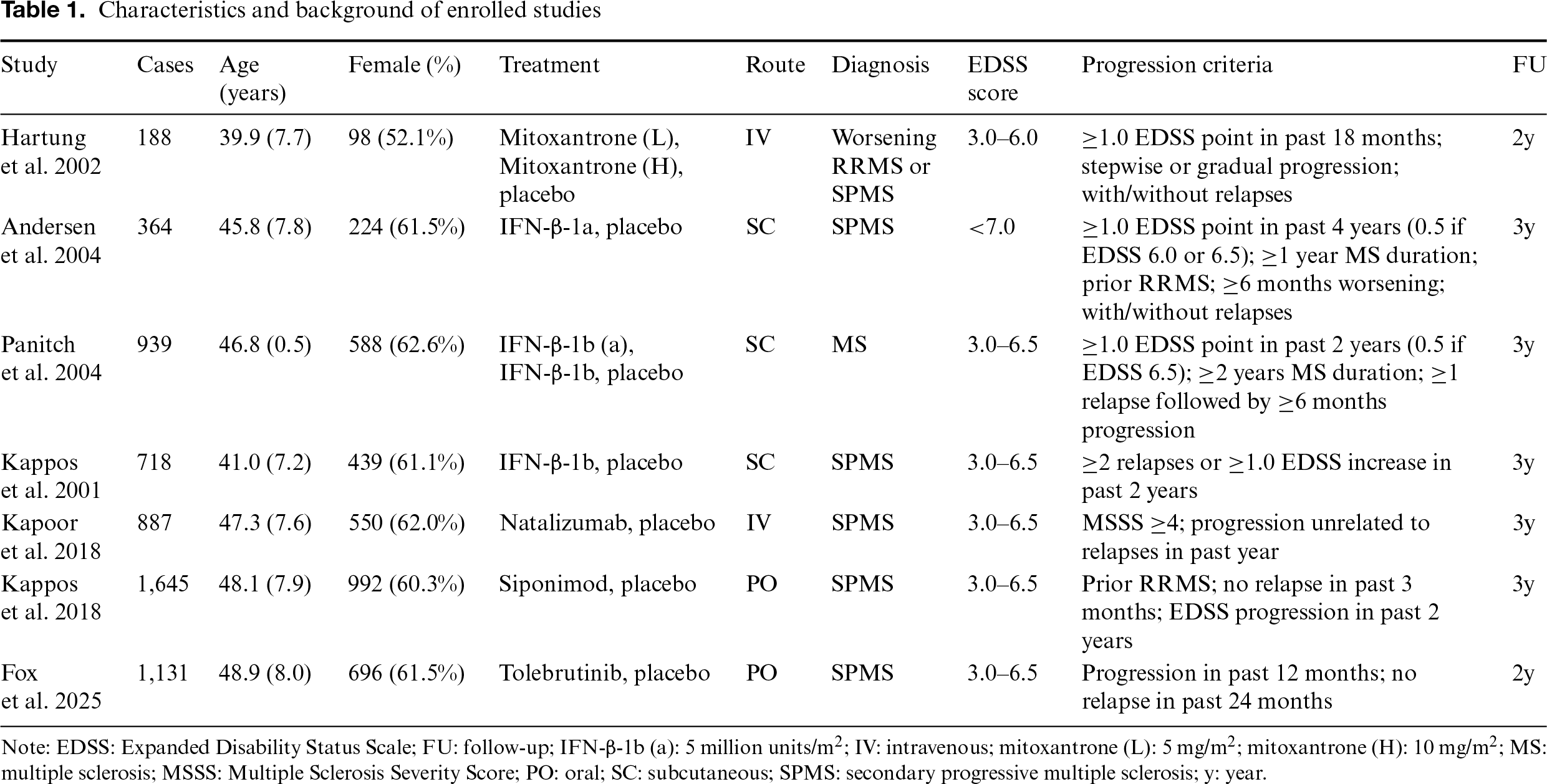
A total of 2,013 unique records were identified through systematic searches of the Cochrane, Embase, PubMed, and Web of Science databases. After initial screening, 188 full-text articles were assessed for eligibility. Of these, 181 were excluded for the following reasons: lack of an RCT design (n = 78), irrelevance to SPMS (n = 57), review articles (n = 34), unavailable data (n = 10), and small sample size (n = 2). Ultimately, seven studies met the inclusion criteria and were included in the final systematic review (Fig. S1). These seven RCTs, comprising a total of 5,872 patients with SPMS, were included in the NMA (Table 1).13–19 The studies evaluated various DMTs, including low- and high-dose mitoxantrone (5 and 10 mg/m2), interferon beta-1a (IFN-β-1a), interferon beta-1b (IFN-β-1b) with both standard and adjusted dosages, natalizumab, siponimod, and tolebrutinib. Placebo arms served as comparators. The mean age of participants ranged from 39.9 to 48.9 years, with women accounting for approximately 60% of each study population. Most trials enrolled patients with EDSS scores between 3.0 and 6.5, indicating moderate to severe disability. Mitoxantrone was excluded from the NMA due to its known risks of cardiotoxicity and leukemia.
Six-Month CDP Outcomes
The network graph of the included studies is presented in Fig. 1A. Two studies compared placebo with IFN-β-1b, while each of the other treatments was assessed in a single study. The direct comparisons are shown in Fig. 2A. Among the interventions, low-dose mitoxantrone demonstrated the lowest OR for 6-month CDP at 0.28 (95% CI: 0.09–0.82), followed by tolebrutinib at 0.66 (95% CI: 0.50–0.87), IFN-β-1b at 0.68 (95% CI: 0.45–1.04), siponimod at 0.72 (95% CI: 0.57–0.92), IFN-β-1a at 0.85 (95% CI: 0.56–1.29), and natalizumab at 0.87 (95% CI: 0.62–1.22).
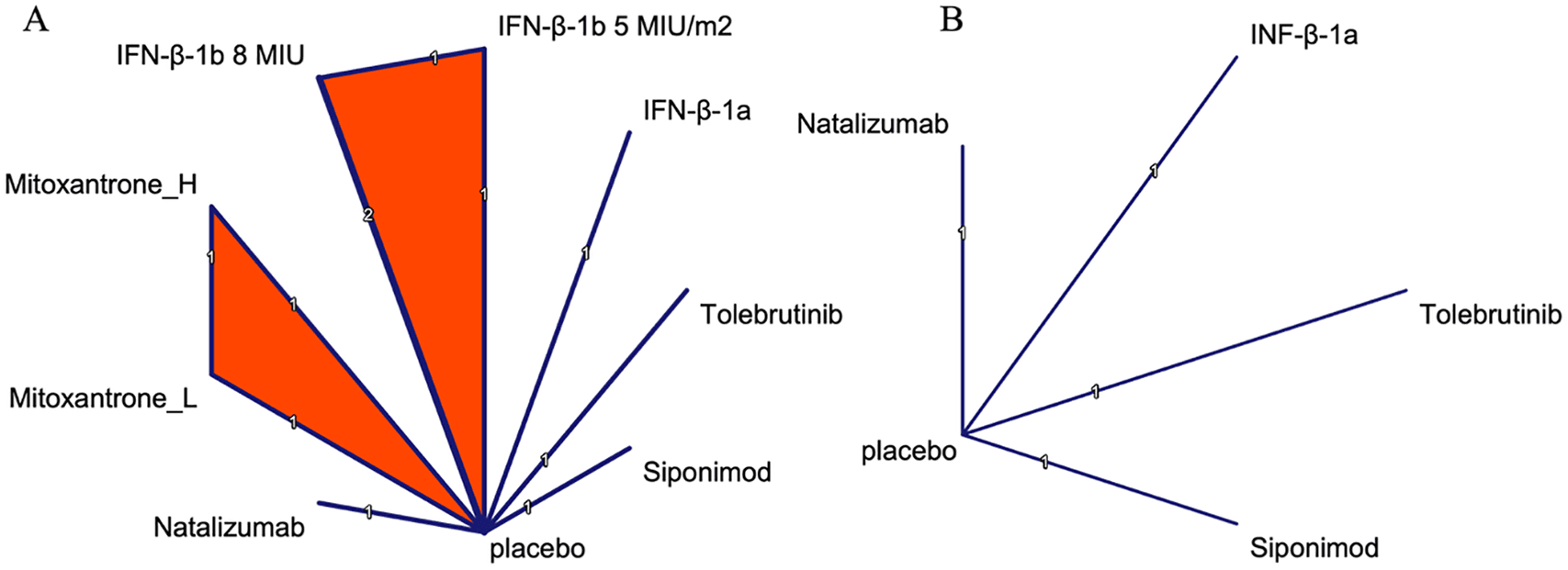
Figure 1. Network graph of enrolled studies. (A) Studies CDP at 3 and 6 months and (B) studies on serious adverse events.
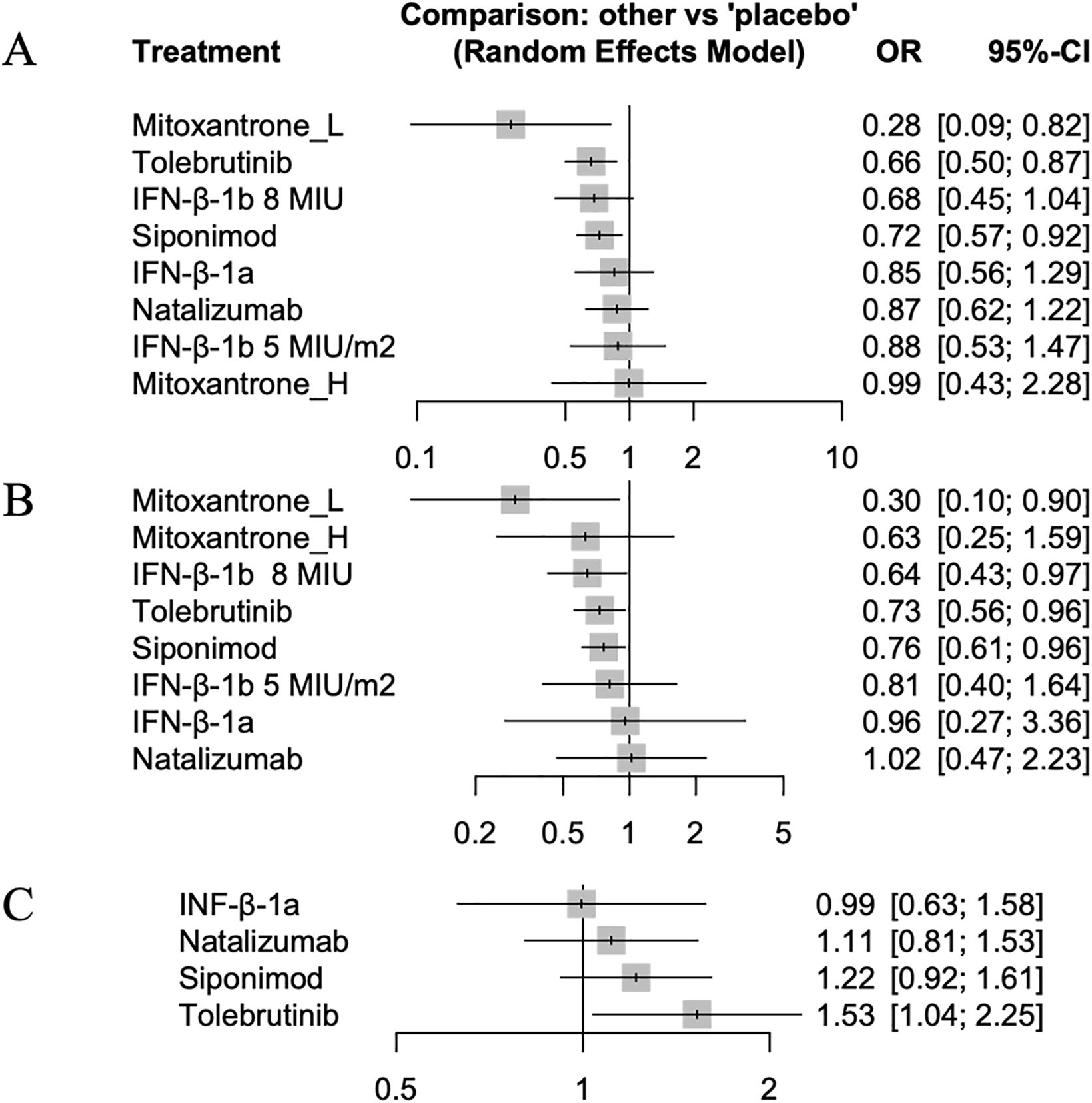
Figure 2. Direct comparison of various treatments. (A) Direct comparison of CDP at 6 months; (B) direct CDP progression at 3 months; (C) direct comparison of the risk of SAEs.
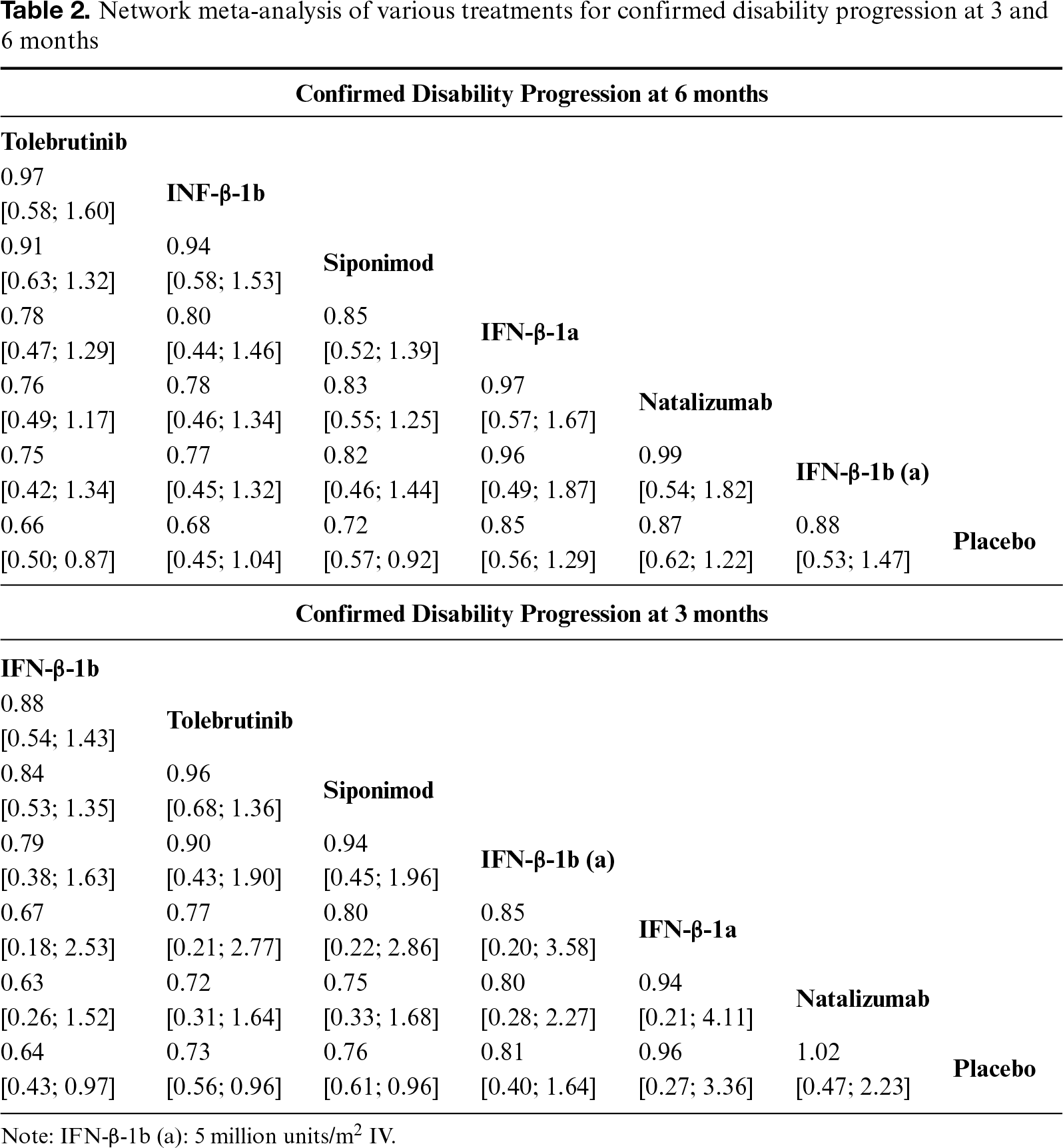
The results of the NMA are summarized in Table 2. Both tolebrutinib and siponimod demonstrated statistically significant superiority over placebo, with ORs consistent with those observed in direct comparisons. No other treatments showed superiority over one another. The relative efficacy of each treatment, based on SUCRA values, is illustrated in Fig. S2: tolebrutinib (0.713), IFN-β-1b (0.645), siponimod (0.606), IFN-β-1a (0.403), IFN-β-1b with adjusted dosage (0.357), natalizumab (0.351), and placebo (0.176). There was no notable heterogeneity (I² = 0%), and no evidence of publication bias was detected using Egger’s test (p = 0.90).
Three-Month CDP Outcomes
The results for 3-month CDP outcomes were generally consistent with those observed at 6 months (Fig. 1A). The direct comparisons are shown in Fig. 2B. Low- and high-dose mitoxantrone demonstrated the lowest ORs for 3-month CDP, at 0.30 (95% CI: 0.10–0.90) and 0.63 (95% CI: 0.25–1.59), respectively. These were followed by IFN-β-1b at 0.64 (95% CI: 0.43–0.97), tolebrutinib at 0.73 (95% CI: 0.56–0.96), siponimod at 0.76 (95% CI: 0.61–0.96), adjusted-dose IFN-β-1b at 0.81 (95% CI: 0.40–1.64), IFN-β-1a at 0.96 (95% CI: 0.27–3.36), and natalizumab at 1.02 (95% CI: 0.47–2.23).
The results of the NMA are presented in Table 2. IFN-β-1b, tolebrutinib, and siponimod showed statistically significant superiority over placebo, with ORs consistent with those from the direct comparisons. No other agents demonstrated superiority over one another. The relative efficacy of each treatment, based on SUCRA values, is shown in Fig. S3: IFN-β-1b (0.663), tolebrutinib (0.554), siponimod (0.497), adjusted-dose IFN-β-1b (0.428), IFN-β-1a (0.356), natalizumab (0.261), and placebo (0.196). There was no evidence of heterogeneity (I² = 0%) and no publication bias was detected using Egger’s test (p = 0.58).
SAEs
The network graph of the enrolled studies is shown in Fig. 1B. Only four agents reported data on SAEs. The results of the direct comparisons are presented in Fig. 2C. IFN-β-1b showed an OR of 0.99 (95% CI: 0.63–1.58), natalizumab had an OR of 1.11 (95% CI: 0.81–1.53), siponimod showed an OR of 1.22 (95% CI: 0.92–1.61), and tolebrutinib had an OR of 1.53 (95% CI: 1.04–2.25).
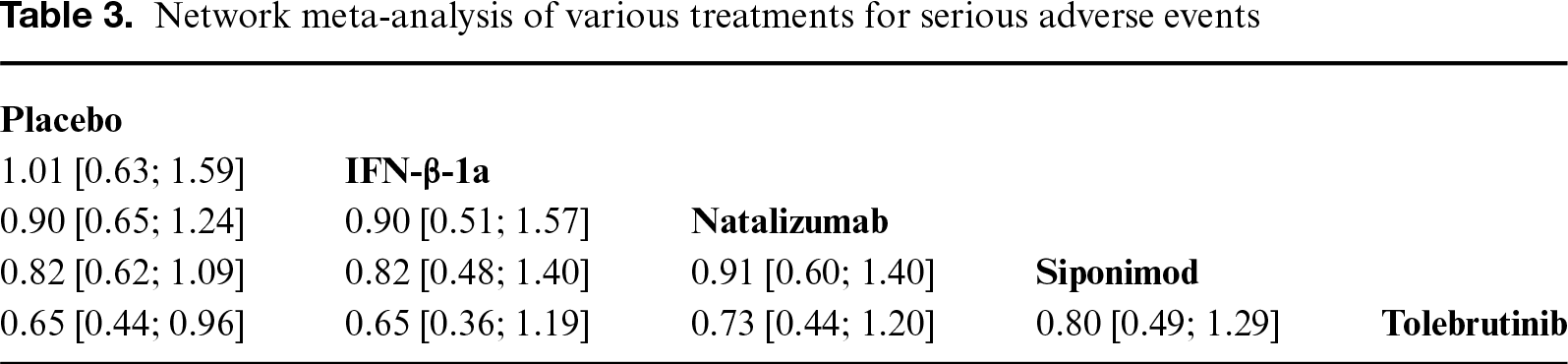
The results of the NMA are presented in Table 3. Tolebrutinib was associated with a significantly higher risk of SAEs compared to placebo, with ORs consistent with those from the direct comparisons. No other agents showed significant differences from each other. The relative safety of each treatment, based on SUCRA values, is shown in Fig. S4. The SUCRA values, rounded to three decimal places, were as follows: placebo (0.782), IFN-β-1a (0.709), natalizumab (0.548), siponimod (0.361), and tolebrutinib (0.101). Due to the small number of included studies, assessments of heterogeneity and publication bias using Egger’s test are not considered reliable.
Risk of Bias and Certainity of Evidence
Risk of bias assessments (Fig. S5) showed that four studies were rated as having some concerns, while the remaining three were judged to have a low risk of bias. The evaluated outcomes included CDP at 3 and 6 months. Overall, the risk of bias was considered to be of some concern. The certainty of evidence for the treatment rankings was rated as moderate, downgraded due to risk of bias.
Discussion
This NMA synthesized evidence from seven RCTs evaluating DMTs for SPMS. The results indicate that tolebrutinib, IFN-β-1b, and siponimod demonstrated significant benefits in delaying CDP at both 3 and 6 months compared to placebo. Notably, tolebrutinib was more effective than IFN-β-1b at 6 months, whereas IFN-β-1b showed greater benefit at 3 months. These findings are consistent with previous reports supporting the efficacy of IFN-β-1b and siponimod,20 while also highlighting the emerging potential of tolebrutinib. In contrast, IFN-β-1a and natalizumab exhibited more modest effects, in line with earlier studies suggesting limited benefits in delaying disability progression.17 This review offers a comprehensive comparison of both established and newer agents by using an NMA framework to rank their relative effectiveness and safety.
Tolebrutinib, a next-generation BTK inhibitor, demonstrated encouraging results with significant benefits at 3 and 6 months.21 Its dual mechanism of action, targeting peripheral immune cells and CNS-resident microglia, offers a promising approach for SPMS, where compartmentalized inflammation drives progression. Nevertheless, concerns remain due to the higher risk of SAEs and the short follow-up, which limits understanding of its long-term safety and efficacy. Real-world evidence from observational cohorts, registries, and post-marketing surveillance will be valuable in assessing durability of benefit, safety, and treatment persistence in broader patient populations. Furthermore, the inclusion of participants without active relapses in several trials may restrict generalizability. Despite these limitations, the findings highlight tolebrutinib’s potential and underscore the need for longer-term studies.
Regarding IFN agents, IFN-β-1b ranked slightly higher than IFN-β-1a, with lower ORs for CDP at both time points. This suggests a somewhat greater immunomodulatory effect, although the overall benefit remains modest and is unlikely to significantly influence long-term outcomes. Similarly, natalizumab demonstrated limited benefit, with ORs close to unity, indicating no significant advantage in delaying disease progression. Mitoxantrone demonstrated the most pronounced short-term efficacy among the evaluated agents; however, its clinical utility is severely limited by a well-documented toxicity profile.22 Notably, the risks of cumulative dose-dependent cardiotoxicity and therapy-related secondary acute myeloid leukemia significantly outweigh its benefits in most settings, thereby precluding its routine use in long-term disease management.23
From a clinical perspective, these findings suggest that siponimod remains the most practical treatment option due to its consistent efficacy and acceptable safety profile, as supported by current guidelines. Tolebrutinib appears promising, particularly for patients with active SPMS, but further evidence is needed to confirm its long-term benefits and safety. In contrast, IFN-based studies relied on older trial designs and outcome measures, which limit their applicability to contemporary clinical practice. Future research should prioritize head-to-head trials comparing tolebrutinib and siponimod in patients with active SPMS to clarify their relative effectiveness in slowing disease progression and preserving quality of life. Longer-term studies are also essential to assess sustained benefits, cognitive outcomes, and patient-reported measures. Additionally, improved standardization of trial criteria is necessary to enhance the generalizability of findings.
Several limitations of this review should be acknowledged. The risk of bias in the included studies raised some concern, and the certainty of evidence was moderate, which limits the strength of the conclusions. The small sample size and inclusion of multiple agents limited safety comparisons and precluded sensitivity analyses. While statistical heterogeneity was low, clinical heterogeneity, including differences in disease activity status, baseline EDSS, and trial durations, should be considered when interpreting the generalizability of these findings. Lastly, although no publication bias was detected, its presence cannot be entirely ruled out.
Conclusion
This systematic review and NMA demonstrated that tolebrutinib, IFN-β-1b, and siponimod are effective in delaying disability progression in SPMS. Although tolebrutinib shows promise, further research is needed to confirm its long-term efficacy and safety. IFN-β-1b and siponimod, with their consistent effectiveness and favorable safety profiles, remain the most practical treatment options. Future head-to-head trials will be critical to refining therapeutic strategies for SPMS.
Acknowledgment
None.
Funding Source
None.
Author Contributions
Y.Y. contributed to the study design and manuscript drafting. Y.Y. and G.Z. performed the literature search, quality assessment, data extraction, and analysis. S.M. and D.Z. contributed to data interpretation and revision. All authors have reviewed the manuscript and agree with its content and data.
Data Availability
The corresponding author will provide the datasets used in this study upon reasonable request.
Ethical Statement
Institutional Review Board approval was waived due to the nature of the meta-analysis.
Conflict of Interest
The authors report no conflicts of interest related to this work.
Supplemental Information
Supplemental information for this article can be found online at https://sup.jclinque.com/api/articles/88/download-suppl.
References
[1] Portaccio E, Magyari M, Havrdova EK, et al. Multiple sclerosis: emerging epidemiological trends and redefining the clinical course. Lancet Reg Health Eur. 2024;44:100977. doi:10.1016/j.lanepe.2024.100977.
[2] Cree BAC, Arnold DL, Chataway J, et al. Secondary progressive multiple sclerosis: new insights. Neurology. August 24, 2021;97(8):378–388. doi:10.1212/wnl.0000000000012323.
[3] Ziemssen T, Bhan V, Chataway J, et al. Secondary progressive multiple sclerosis: a review of clinical characteristics, definition, prognostic tools, and disease-modifying therapies. Neurol Neuroimmunol Neuroinflamm. January 2023;10(1):90. doi:10.1212/nxi.0000000000200064.
[4] Rojas JI, Patrucco L, Alonso R, et al. Diagnostic uncertainty during the transition to secondary progressive multiple sclerosis: multicenter study in Argentina. Mult Scler. April 2021;27(4):579–584. doi:10.1177/1352458520924586.
[5] Bsteh G, Dal-Bianco A, Krajnc N, Berger T. Biomarkers of progression independent of relapse activity-can we actually measure it yet? Int J Mol Sci. May 14, 2025;26(10):4704. doi:10.3390/ijms26104704.
[6] Rocca MA, Preziosa P, Barkhof F, et al. Current and future role of MRI in the diagnosis and prognosis of multiple sclerosis. Lancet Reg Health Eur. September 2024;44(2):100978. doi:10.1016/j.lanepe.2024.100978.
[7] Oreja-Guevara C, Meca-Lallana JE, Gómez-Estévez I, et al. Economic burden of secondary progressive multiple sclerosis: DISCOVER study. BMC Health Serv Res. April 10, 2025;25(1):525. doi:10.1186/s12913-025-12592-1.
[8] Mrochen A, Meuth SG, Pfeuffer S. Should we stay or should we go? Recent insights on drug discontinuation in multiple sclerosis. Neurol Res Pract. April 21, 2025;7(1):25. doi:10.1186/s42466-025-00379-y.
[9] Hua LH, Bar-Or A, Cohan SL, et al. Effects of baseline age and disease duration on the efficacy and safety of siponimod in patients with active SPMS: post hoc analyses from the EXPAND study. Mult Scler Relat Disord. July 2023;75(10):104766. doi:10.1016/j.msard.2023.104766.
[10] Dumitrescu L, Papathanasiou A, Coclitu C, et al. An update on the use of sphingosine 1-phosphate receptor modulators for the treatment of relapsing multiple sclerosis. Expert Opin Pharmacother. March 2023;24(4):495–509. doi:10.1080/14656566.2023.2178898.
[11] Bayas A, Christ M, Faissner S, et al. Disease-modifying therapies for relapsing/active secondary progressive multiple sclerosis - a review of population-specific evidence from randomized clinical trials. Ther Adv Neurol Disord. 2023;16:17562864221146836. doi:10.1177/17562864221146836.
[12] Krämer J, Bar-Or A, Turner TJ, Wiendl H. Bruton tyrosine kinase inhibitors for multiple sclerosis. Nat Rev Neurol. May 2023;19(5):289–304. doi:10.1038/s41582-023-00800-7.
[13] Hartung HP, Gonsette R, König N, et al. Mitoxantrone in progressive multiple sclerosis: a placebo-controlled, double-blind, randomised, multicentre trial. Lancet. December 21–28, 2002;360(9350):2018–2025. doi:10.1016/s0140-6736(02)12023-x.
[14] Andersen O, Elovaara I, Färkkilä M, et al. Multicentre, randomised, double blind, placebo controlled, phase III study of weekly, low dose, subcutaneous interferon beta-1a in secondary progressive multiple sclerosis. J Neurol Neurosurg Psychiatry. May 2004;75(5):706–710. doi:10.1136/jnnp.2003.010090.
[15] Panitch H, Miller A, Paty D, Weinshenker B. Interferon beta-1b in secondary progressive MS: results from a 3-year controlled study. Neurology. November 23, 2004;63(10):1788–1795. doi:10.1212/01.wnl.0000146958.77317.3e.
[16] Kappos L, Polman C, Pozzilli C, Thompson A, Beckmann K, Dahlke F. Final analysis of the European multicenter trial on IFNbeta-1b in secondary-progressive MS. Neurology. December 11, 2001;57(11):1969–1975. doi:10.1212/wnl.57.11.1969.
[17] Kapoor R, Ho PR, Campbell N, et al. Effect of natalizumab on disease progression in secondary progressive multiple sclerosis (ASCEND): a phase 3, randomised, double-blind, placebo-controlled trial with an open-label extension. Lancet Neurol. May 2018;17(5):405–415. doi:10.1016/s1474-4422(18)30069-3.
[18] Kappos L, Bar-Or A, Cree BAC, et al. Siponimod versus placebo in secondary progressive multiple sclerosis (EXPAND): a double-blind, randomised, phase 3 study. Lancet. March 31, 2018;31(10127):1263–1273. doi:10.1016/s0140-6736(18)30475-6.
[19] Fox RJ, Bar-Or A, Traboulsee A, et al. Tolebrutinib in nonrelapsing secondary progressive multiple sclerosis. N Engl J Med. May 15, 2025;392(19):1883–1892. doi:10.1056/NEJMoa2415988.
[20] Cortesi PA, Antonazzo IC, Gasperini C, Nica M, Ritrovato D, Mantovani LG. Cost-effectiveness and budget impact analysis of siponimod in the treatment of secondary progressive multiple sclerosis in Italy. PLoS One. 2022;17(3):e0264123. doi:10.1371/journal.pone.0264123.
[21] Airas L, Bermel RA, Chitnis T, et al. A review of Bruton’s tyrosine kinase inhibitors in multiple sclerosis. Ther Adv Neurol Disord. 2024;17:17562864241233041. doi:10.1177/17562864241233041.
[22] Brück W, Gold R, Lund BT, et al. Therapeutic decisions in multiple sclerosis: moving beyond efficacy. JAMA Neurol. October 2013;70(10):1315–1324. doi:10.1001/jamaneurol.2013.3510.
[23] Shaikh AY, Suryadevara S, Tripathi A, et al. Mitoxantrone-induced cardiotoxicity in acute myeloid leukemia-a velocity vector imaging analysis. Echocardiography. August 2016;33(8):1166–1177. doi:10.1111/echo.13245.
 |
Copyright © 2025 Yin et al. This work is licensed under a Creative Commons Attribution 4.0 International License, which permits unrestricted use, distribution, and reproduction in any medium, provided the original work is properly cited. |