| Journal of Clinical Question. 2025; 2(4): e82 https://doi.org/10.69854/jcq.2025.0023 Advance access publication date 19 August 2025 |
 |
Meta-Analysis
Comparative Efficacy and Safety of Tolebrutinib Versus Biologic Agents in Relapsing Multiple Sclerosis: A Systematic Review and Network Meta-Analysis
Ye Yin1, Jinmei Gao 2, Danyu Zhao3,*
1Ultrasound Electrocardiology Center, Affiliated Hospital of Liaoning University of Traditional Chinese Medicine, Shenyang, China.
2Department of Ultrasound, Shenyang Maternity and Child Health Hospital, Shenyang, China.
3College of Integrated Traditional Chinese and Western Medicine, Liaoning University of Traditional Chinese Medicine, Shenyang, China.
*Corresponding Author: e-mail: zhaody781107@163.com
Submitted: July 02, 2025 Accepted: August 18, 2025
Clinical Question Box
In patients with relapsing multiple sclerosis, does tolebrutinib demonstrate superior efficacy and safety, compared to antibody-based therapies?
Current evidence does not support the superiority of tolebrutinib over antibody-based therapies in efficacy or safety. While tolebrutinib offers a convenient oral alternative and demonstrates moderate effectiveness in preventing confirmed disability progression and serious adverse events, it appears less effective in controlling annualized relapse rates. Overall, monoclonal antibodies remain more effective in reducing both relapse frequency and disability progression in patients with relapsing multiple sclerosis.
Abstract
Introduction: Relapsing multiple sclerosis (RMS) is a chronic autoimmune disease with an expanding range of treatment options, including monoclonal antibodies and emerging oral agents such as tolebrutinib. This network meta-analysis aims to compare the efficacy and safety of tolebrutinib with those of established antibody-based therapies for RMS. Methods: A systematic review and network meta-analysis were conducted using a frequentist framework in R. Randomized controlled trials (RCTs) were systematically searched. The primary outcomes were annualized relapse rate (ARR), confirmed disability progression (CDP), and serious adverse events (SAEs). Mean differences (MDs) and odds ratios (ORs) were calculated, along with their corresponding 95% confidence intervals (CIs). Results: Ten RCTs involving 11,365 patients with RMS evaluated tolebrutinib, ocrelizumab, ofatumumab, ublituximab, alemtuzumab, and natalizumab. For ARR compared to placebo, natalizumab showed the highest efficacy (MD: −50%, 95% CI: −64% to −40%), followed by alemtuzumab (MD: −51%, 95% CI: −69% to −33%) and ocrelizumab (MD: −39%, 95% CI: −48% to −29%). Compared to tolebrutinib, all biologics demonstrated greater ARR reduction, with statistically significant differences for alemtuzumab (MD: −31%, 95% CI: −53% to −10%), natalizumab (MD: −32%, 95% CI: −47% to −17%), and ocrelizumab (MD: −21%, 95% CI: −41% to −1%). For CDP, ocrelizumab ranked the highest (OR: 0.16, 95% CI: 0.06–0.42), followed by alemtuzumab (OR: 0.30, 95% CI: 0.12–0.75) and natalizumab (OR: 0.35, 95% CI: 0.13–0.91). Tolebrutinib demonstrated moderate efficacy, with no significant inferiority compared to antibody-based treatments. Regarding SAEs, natalizumab exhibited the most favorable safety profile (OR: 0.22, 95% CI: 0.07–0.67), while that of tolebrutinib was comparable to other agents. Conclusion: Monoclonal antibodies such as natalizumab, alemtuzumab, and ocrelizumab remain among the most effective therapies for RMS. Tolebrutinib provides a convenient oral alternative with comparable safety and moderate efficacy in preventing disability progression.
Keywords: Relapsing multiple sclerosis, tolebrutinib, monoclonal antibodies, network meta-analysis
Introduction
Multiple sclerosis (MS) is a chronic autoimmune disease characterized by demyelination and neurodegeneration of the central nervous system, typically presenting between ages 20 and 40 and disproportionately affecting women.1 It occurs when the immune system attacks the myelin sheath surrounding nerve fibers, leading to inflammation, disrupted neural communication, and progressive neurological impairment.2 It is classified into four courses. Clinically isolated syndrome involves a single neurological episode with possible silent CNS damage detected on MRI, potentially leading to a full MS diagnosis. Relapsing-remitting MS (RRMS), the most common form, features recurrent attacks with periods of remission; treatment can reduce or prevent relapses. Secondary-progressive MS (SPMS) follows RRMS, with gradually worsening symptoms and fewer or no relapses, termed “active” if attacks continue and “non-relapsing” otherwise. Primary-progressive MS (PPMS) causes steady symptom progression from onset without distinct relapses.3 The term “relapsing MS” (RMS) is frequently used in recent studies.4,5 Although the inclusion criteria vary, RMS cohorts typically consist of more than 90% RRMS patients, along with a small percentage of SPMS and others.6
RRMS is the most common form of MS, accounting for roughly 85%–87% of initial diagnoses.7 Recent epidemiological data indicate that approximately 2.9 million people worldwide live with MS (around 24 to 36 per 100,000 population), with incidence estimates ranging from 2 to 8 per 100,000 person-years depending on the region.8,9 Clinically, RMS is characterized by episodic relapses followed by residual or accumulating disability, including physical impairment, fatigue, cognitive deficits, and reduced quality of life.10 It also imposes substantial economic strain, at approximately USD 85 billion annually in the United States, fueled by direct medical costs and elevated treatment expenditures averaging USD 90,000 per patient each year.11 Collectively, RMS poses an escalating global burden that deeply impacts individuals, caregivers, healthcare systems, and society.
Over the past two decades, treatment approaches for RMS have advanced substantially. Early disease-modifying therapies (DMTs), including interferon-β and glatiramer acetate, provided only moderate reductions in annualized relapse rates (around 30%) and were constrained by injectable delivery and tolerability issues.12 The development of oral agents, such as fingolimod, teriflunomide, dimethyl fumarate, siponimod, ozanimod, and cladribine, improved both patient adherence and therapeutic outcomes.13 However, highly effective infusion therapies have since taken precedence in clinical practice. Among these, monoclonal antibodies targeting CD20 have notably transformed the treatment landscape. One key example, ocrelizumab, gained approval in 2017 and demonstrated significant benefits in reducing relapses and delaying disability progression in clinical trials.14 Other agents, such as ofatumumab (administered subcutaneously), along with ublituximab, alemtuzumab, and natalizumab (administered intravenously), have also demonstrated comparable efficacy. These therapies continue to offer strong relapse control and expand the range of effective treatment options for RMS.15
While monoclonal antibody-based DMTs have demonstrated superiority over traditional treatments, direct comparisons among these agents remain limited.16 Tolebrutinib, a newly developed oral therapy, and Bruton’s tyrosine kinase (BTK) inhibitor, has shown efficacy in RMS, highlighting the need for broader comparisons across high-efficacy therapies. Previous systematic reviews have focused on select monoclonal antibodies and often assessed efficacy and safety separately.17 To address these gaps, we conducted a PRISMA (Preferred Reporting Items for Systematic reviews and Meta-Analyses)-compliant systematic review and network meta-analysis to evaluate and rank approved monoclonal antibodies and tolebrutinib based on both efficacy and safety. This integrated approach aims to support more individualized and evidence-based treatment decisions for RMS.
Methods
Protocol and Registration
This systematic review and network meta-analysis were conducted per the PRISMA 2020 guidelines and the PRISMA extension statement for network meta-analyses. The protocol was prospectively registered in the Open Science Framework (osf.io/jhr6t).
Eligibility Criteria
The inclusion criteria were as follows: (1) randomized controlled trial (RCTs); (2) adult patients (≥18), (3) >90% of participants diagnosed with RRMS, (4) comparison of antibody-based DMTs with placebo or active comparators, and (5) RCTs involving teriflunomide, as it was commonly used as a control. The following were the exclusion criteria: (1) no extractable safety or efficacy outcomes, (2) non-RCT designs, and (3) subgroup analysis of previous studies without adding new information.
Information Sources
We systematically searched the Cochrane Library, Embase, Web of Science, and PubMed databases from their inception up to May 31, 2025. Additionally, we screened the reference lists of relevant systematic reviews and key articles. No restrictions were applied regarding language or publication status. The following search terms were used: ((((((Relapsing Multiple Sclerosis) OR (RMS)) OR (Relapsing-remitting Multiple Sclerosis)) OR (RRMS)) AND (((antibody) OR (antibody)) OR (inhibitor))) AND (((Teriflunomide) OR (placebo)) OR (interferon-β))) AND ((RCT) OR (Randomized clinical trial)).
Selection Process
Two reviewers (Y.Y. and J.G.) independently screened titles and abstracts, followed by full-text assessments for eligibility. Discrepancies were resolved through discussion or consultation with a third reviewer (D.Z.). Inter-reviewer agreement was measured using Cohen’s kappa statistics. Data extraction was conducted independently by the same two reviewers using a standardized form. The extracted information included study characteristics (year, design, sample size), population demographics, intervention details (antibody type, dose, duration), comparators, efficacy outcomes (annualized relapse rate [ARR], confirmed disability progression [CDP], and safety outcomes of serious adverse events (SAEs). When data was missing or unclear, the study authors were contacted for clarification.
Summary Measures and Data Synthesis
We performed a network meta-analysis using a frequentist framework and random-effects models to estimate relative treatment effects. The ARRs were compared between antibody-based therapies and controls using mean difference (MD) based on percentage change, while binary safety outcomes were analyzed using odds ratio (OR), both with 95% credible intervals (CI). To rank treatments, we calculated the surface under the cumulative ranking curve (SUCRA) for each outcome. A network geometry plot was used to visualize treatment comparisons. Consistency between direct and indirect evidence was assessed using node-splitting methods and the design-by-treatment interaction model. Heterogeneity was evaluated using between-study variance (τ²) and I2 statistics. All analyses were performed in R (version 4.4.1) using the netmeta package.
Bias and Certainty of Evidence
The study quality was assessed using the Cochrane Risk of Bias 2.0 tool across five domains: randomization process, deviations from intended interventions, missing outcome data, outcome measurement, and selective reporting. Two reviewers independently conducted the assessments, resolving any disagreements through consensus. Publication bias was evaluated using Egger’s test where applicable, and selective reporting was further assessed by comparing the reported outcomes with trial registry entries. The certainty of evidence for each pairwise comparison across key outcomes was rated using the GRADE (Grading of Recommendations Assessment, Development, and Evaluation) framework, adapted for network meta-analysis. This assessment considered the risk of bias, inconsistency, indirectness, imprecision, and publication bias.
Results
Study Selection and Characteristics
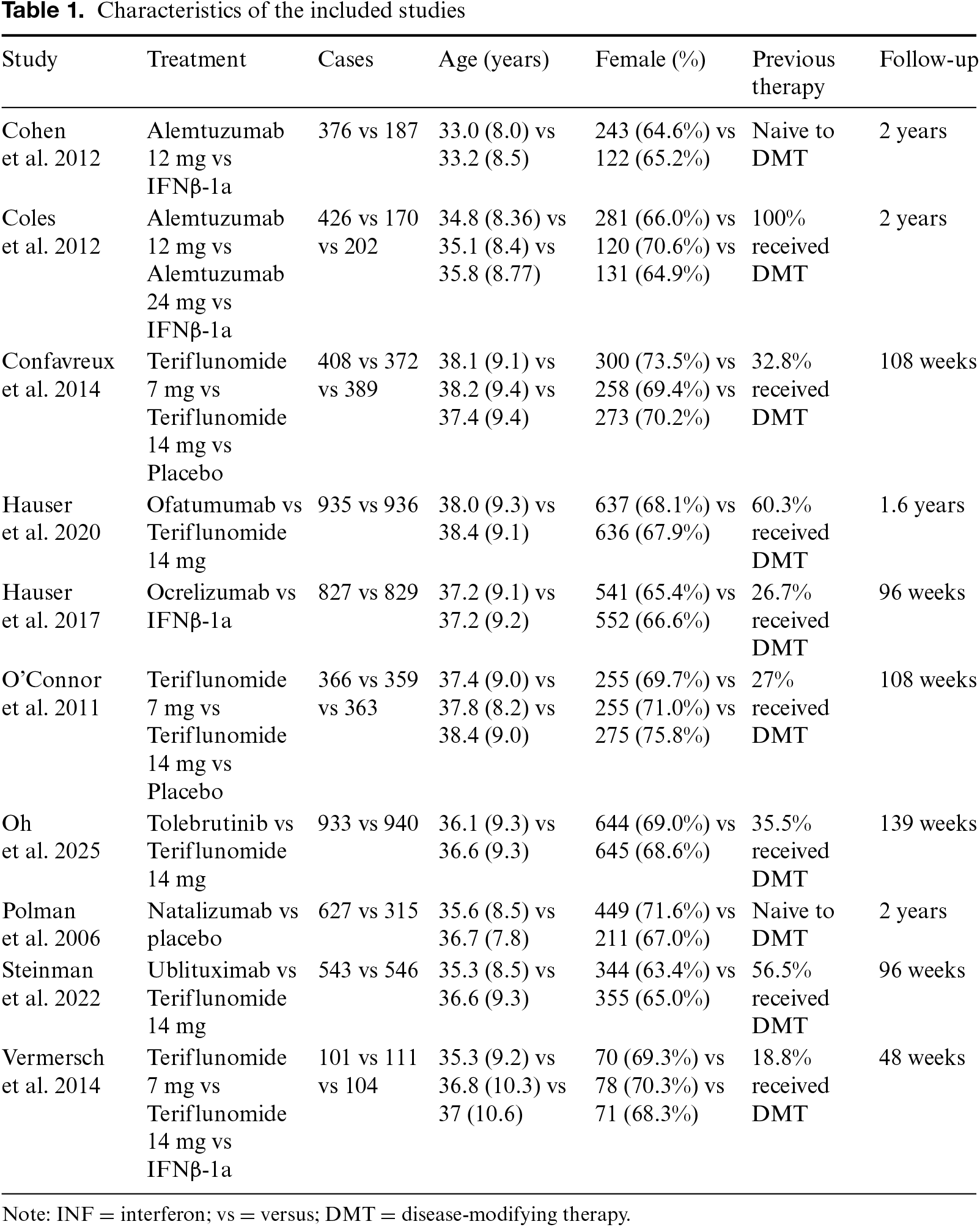
The initial search yielded a total of 1,779 records. By removing duplicates and screening abstracts, 297 and 1,373 records were excluded, respectively. Subsequently, 109 articles were assessed for eligibility (Fig. S1). Ten RCTs involving 11,365 patients were included in the final analysis (Table 1).18–27 The trials evaluated tolebrutinib along with five other antibody-based therapies: ocrelizumab, ofatumumab, ublituximab, alemtuzumab, and natalizumab, comparing them either to a placebo or other active treatments. Most studies had a median follow-up of 12–24 months and included adult patients, with the majority diagnosed with RRMS. Prior DMT use varied across studies: some included only treatment-naive patients,18,25 while others enrolled participants with partial prior DMT exposure (from 18.8% to 60.3%), and one study included only patients with prior DMT use.19
ARR
The network graph of the included studies evaluating ARR is presented in Fig. S2. Most antibody-based agents were compared with teriflunomide. The direct effects of each agent versus the placebo are illustrated in Fig. 1B. Among all agents, natalizumab demonstrated the highest efficacy, with a MD reduction in ARR of 50% (95% CI: −63% to −37%), followed by alemtuzumab (MD: −50%, 95% CI: −72% to −27%), ocrelizumab (MD: −39%, 95% CI: −60% to −18%), ofatumumab (MD: −31%, 95% CI: −39% to −23%), ublituximab (MD: −28%, 95% CI: −38% to −8%), interferon beta-1a (IFNβ-1a) (MD: −26%, 95% CI: −46% to −6%), and tolebrutinib (MD: −18%, 95% CI: −25% to −11%).
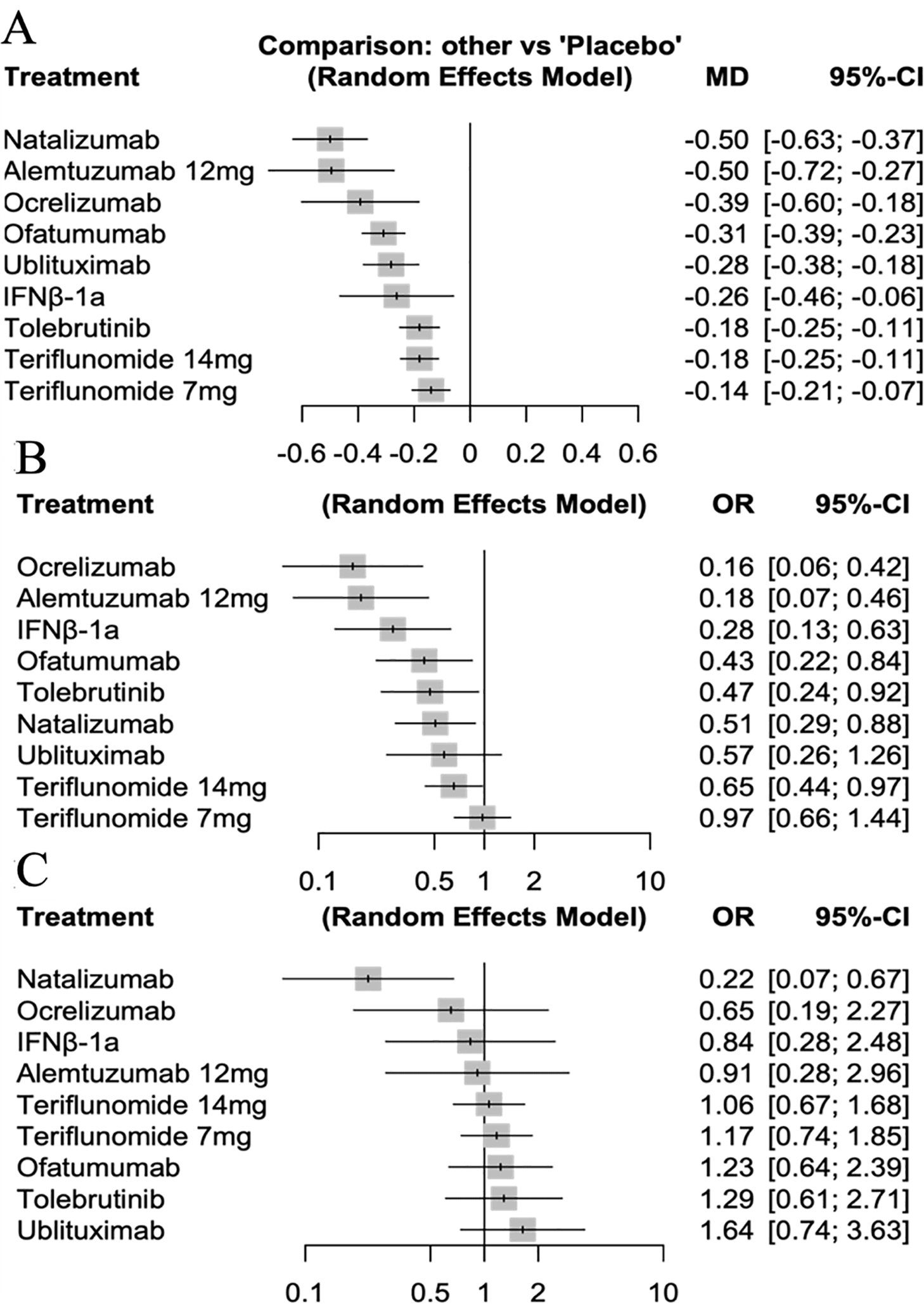
Figure 1. Direct comparisons of the included studies. (A) Direct comparisons for ARR; (B) direct comparisons for CDP; (C) direct comparisons for SAEs.
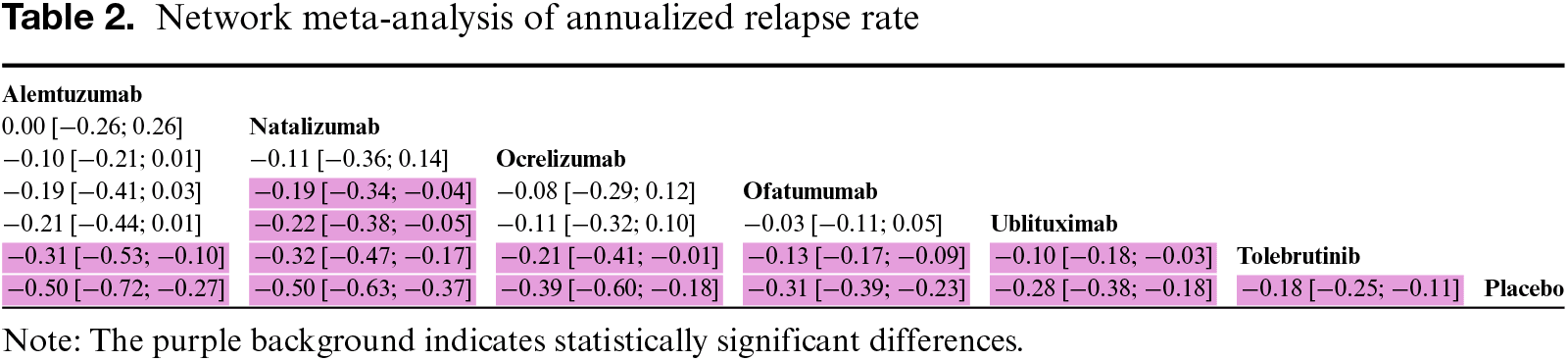
The results of the network meta-analysis are summarized in Table 2. Alemtuzumab showed the greatest efficacy with a MD of −50% in ARR compared with placebo (95% CI: −72% to −27%), followed closely by natalizumab (MD: −50%, 95% CI: −63% to −37%), ocrelizumab (MD: −39%, 95% CI: −60% to −18%), ublituximab (MD: −28%, 95% CI: −38% to −18%), and tolebrutinib (MD: −25% to −10%). All antibody-based agents showed efficacy superior to tolebrutinib, with MDs for alemtuzumab (MD: −31%, 95% CI: −53% to −10%), natalizumab (MD: −32%, 95% CI: −47% to −17%), ocrelizumab (MD: −21%, 95% CI: −41% to −1%), ofatumumab (MD: −13%, 95% CI: −17% to −9%), and ublituximab (MD: −10%, 95% CI: −18% to −3%). The full data of the network meta-analysis, including teriflunomide, is shown in Table S1. The efficacy ranking is illustrated in Fig. S3. Based on SUCRA values, natalizumab (0.9244) and alemtuzumab 12 mg (0.9131) ranked highest in efficacy, followed by ocrelizumab (0.7639), ofatumumab (0.6244), ublituximab (0.5579), tolebrutinib (0.2750), and placebo. Heterogeneity was low, with I2 = 0%, and there was no significant publication bias (Egger’s test p = 0.59).
CDP
The network graph of the included studies evaluating confirmed CDP is shown in Fig. S4. Most biological agents were compared to teriflunomide. The direct comparisons of each agent versus placebo are illustrated in Fig. 1B. Among all agents, ocrelizumab demonstrated the highest efficacy in reducing CDP, with an OR of 0.16 (95% CI: 0.06–0.42), followed by alemtuzumab (OR: 0.18, 95% CI: 0.07–0.46), IFNβ-1a (OR: 0.28, 95% CI: 0.13–0.63), ofatumumab (OR: 0.28, 95% CI: 0.13–0.63), tolebrutinib (OR: 0.43, 95% CI: 0.22–0.84), natalizumab (OR: 0.51, 95% CI: 0.29–0.88), and ublituximab (OR: 0.57, 95% CI: 0.26–1.26).
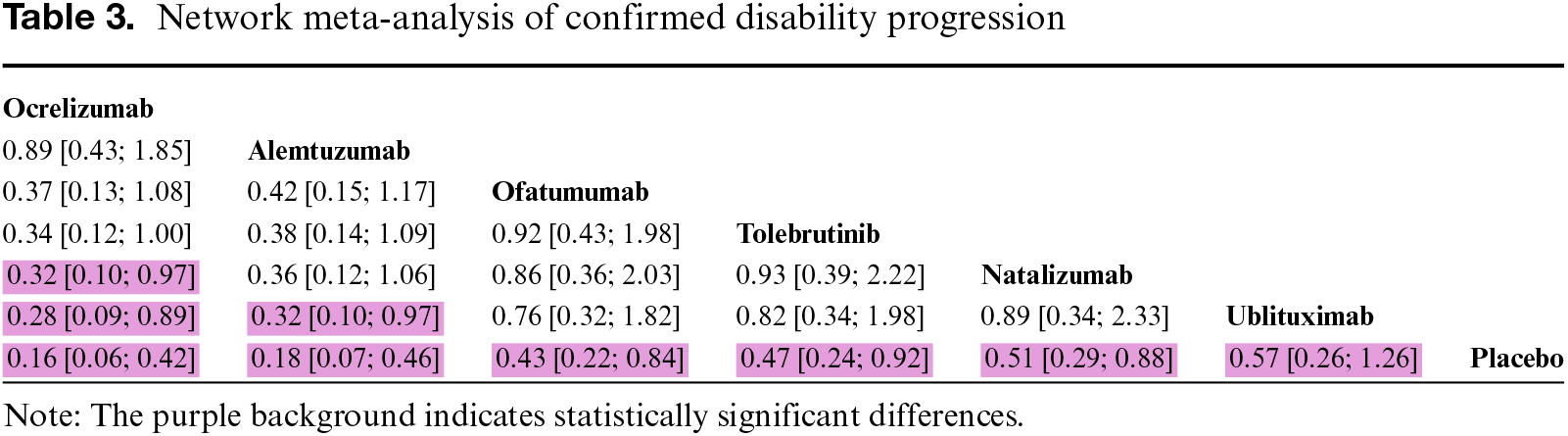
The results of the network meta-analysis are summarized in Table 3. Ocrelizumab showed the greatest efficacy in preventing CDP, with an OR of 0.16 vis-à-vis the placebo (95% CI: 0.06–0.42). The results for the other agents were consistent with those from the direct comparisons. In head-to-head comparisons, ocrelizumab was significantly more effective than natalizumab (OR: 0.32, 95% CI: 0.10–0.97) and ublituximab (OR: 0.28, 95% CI: 0.09–0.89). Similarly, the efficacy of alemtuzumab was superior to that of ublituximab (OR: 0.32, 95% CI: 0.10–0.97). Tolebrutinib was neither superior nor inferior to the other antibody-based agents. Complete network meta-analysis results, including data for teriflunomide, are presented in Table S2. The efficacy ranking of treatments is illustrated in Fig. S5. Based on SUCRA values, ocrelizumab ranked the highest in efficacy (0.928), followed by ofatumumab (0.561), tolebrutinib (0.499), natalizumab (0.461), and ublituximab (0.407). Heterogeneity was low, with I2 = 12%, and there was no significant publication bias (Egger’s test p = 0.68).
SAEs
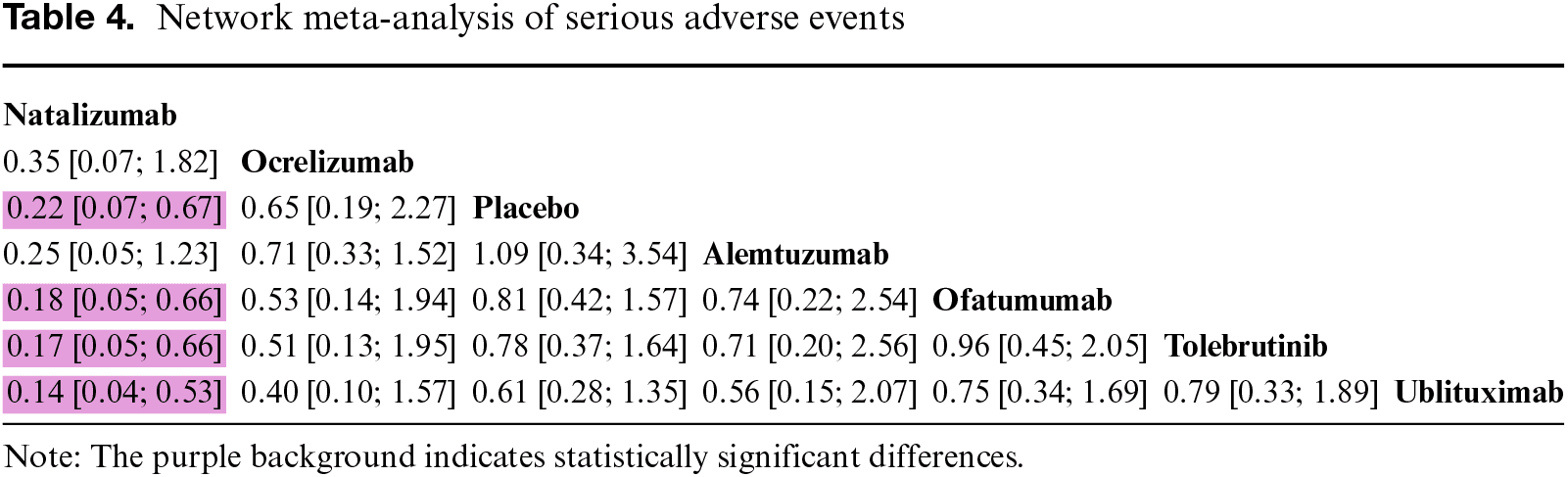
The network graph of the included studies evaluating confirmed SAEs is presented in Fig. S6. Most biological agents were compared with teriflunomide, while direct comparisons of each agent versus the placebo are shown in Fig. 1C. Among all agents, natalizumab demonstrated the highest safety profile in terms of SAEs, with an OR of 0.22 (95% CI: 0.07–0.67), indicating a significantly lower risk than the placebo. This was followed by ocrelizumab (OR: 0.65, 95% CI: 0.19–2.27), IFNβ-1a (OR: 0.84, 95% CI: 0.28–2.48), alemtuzumab (OR: 0.91, 95% CI: 0.28–2.48), ofatumumab (OR: 1.23, 95% CI: 0.64–2.39), tolebrutinib (OR: 1.29, 95% CI: 0.61–2.71), and ublituximab (OR: 1.64, 95% CI: 0.74–3.63).
The results of the network meta-analysis are summarized in Table 4. The ORs for each agent were consistent with those from the direct comparisons. Natalizumab was the only treatment with a statistically significant reduction in SAEs, compared to the placebo. All other agents showed no significant difference, neither superior nor inferior, compared to the placebo. Complete network meta-analysis results, including data for teriflunomide, are available in Table S3, and the treatment ranking is illustrated in Fig. S7. According to SUCRA values, natalizumab ranked the highest (0.980), followed by ocrelizumab (0.711), alemtuzumab (0.550), placebo (0.510), ofatumumab (0.336), tolebrutinib (0.295), and ublituximab (0.170). Heterogeneity was moderate (I2 = 26%), and no significant publication bias was detected (Egger’s test p = 0.70).
Risk of Bias and Certainty of Evidence
The risk of bias is presented in Fig. S8. Only one study raised some concerns due to missing outcome data and selective reporting, while the remaining studies were assessed as having a low risk of bias. The certainty of evidence indicating that tolebrutinib is less effective than biological agents in terms of ARR was rated as moderate. There was also moderate certainty of evidence suggesting no difference in CDP and SAEs.
Discussion
This network meta-analysis provides a comprehensive comparison of tolebrutinib with five antibody-based biological agents: ocrelizumab, ofatumumab, ublituximab, alemtuzumab, and natalizumab, in patients with RMS. Based on ten RCTs involving more than 11,000 patients, the analysis revealed that alemtuzumab and natalizumab produced the greatest reductions in ARR, whereas ocrelizumab demonstrated the highest efficacy in preventing CDP. Notably, natalizumab also ranked the best in terms of safety, with a significant reduction in SAEs. Although tolebrutinib was less effective than biologics in reducing ARR, it showed moderate efficacy in preventing CDP, with no statistically significant inferiority compared to any of the antibody-based agents. These findings align with previous studies underscoring the high efficacy of natalizumab and alemtuzumab in relapse prevention and confirm ocrelizumab’s superiority in reducing disability progression.15 Importantly, this is the first network meta-analysis to directly compare tolebrutinib with these biologics, offering new insights into their relative clinical performance.
The certainty of evidence indicating that tolebrutinib is less effective than biological agents in reducing ARR was rated as moderate. Conversely, there was also moderate certainty of evidence suggesting no significant difference between tolebrutinib and biologics regarding CDP and SAEs. These results suggest that while tolebrutinib may offer a smaller benefit in relapse prevention, its effectiveness in delaying disability progression and safety profile are comparable to those of established biologics. Tolebrutinib holds distinct advantages that may complement existing RMS therapies. Unlike monoclonal antibodies, administered intravenously or subcutaneously, tolebrutinib is an oral agent that offers convenience and the potential for improved adherence.28 It penetrates the blood-brain barrier and targets both peripheral B cells and CNS-resident microglia, a dual mechanism not shared by traditional biologics.29 While its ARR-reducing efficacy was lower than that of natalizumab and alemtuzumab, the oral route of administration and novel mechanism make tolebrutinib an attractive option, particularly for patients seeking non-infusion-based treatments or intolerant to injectable therapies.
Multiple factors may contribute to the differences observed in efficacy and safety between tolebrutinib and biologic agents. First, the mechanisms of action differ; tolebrutinib, as a BTK inhibitor, has a broader immunomodulatory effect, including CNS penetration, which may influence CDP more than ARR. Second, variability in study populations, particularly in baseline disease activity, demographic characteristics, and the proportion of patients with prior DMT exposure, may have affected outcomes. Notably, differences in prior DMT use across trials could impact both relapse risk and treatment response. Third, heterogeneity in trial design, outcome definitions, and reporting practices may limit the reliability of indirect comparisons. Further, the included studies span a prolonged period during which diagnostic criteria for RMS evolved, potentially leading to differences in disease stage at enrollment. Finally, as the role of BTK inhibitors in MS continues to be defined, longer-term and head-to-head trials are required to clarify their position vis-à-vis established biologics.
This analysis has several limitations. First, heterogeneity in study designs, baseline characteristics, and follow-up durations may have influenced the outcomes, although statistical heterogeneity was low to moderate. Second, as with all network meta-analyses, indirect comparisons rely on the assumption of transitivity and cannot replace direct head-to-head trials. Third, the short follow-up in some tolebrutinib trials limits conclusions regarding long-term safety and efficacy. Finally, SUCRA rankings offer a useful estimation of treatment hierarchy but should not be interpreted as definitive clinical guidance.
Conclusion
This network meta-analysis suggests that while antibody-based therapies, particularly natalizumab, alemtuzumab, and ocrelizumab, remain highly effective in managing relapsing MS, tolebrutinib offers a promising oral alternative with a comparable safety profile and moderate efficacy. Its ease of use and novel mechanism make it a valuable addition to the MS treatment spectrum, especially for patients who prioritize oral administration or seek alternatives to biological therapies. Future head-to-head trials and long-term observational studies are required to further clarify its comparative effectiveness and safety.
Acknowledgments
None.
Funding Source
None.
Author Contributions
Y.Y. contributed to the study design and drafting. Y.Y. and J.G. contributed to the study search, quality control, data extraction, and analysis. Y.Y. and D.Z. worked on data interpretation and revision. All authors have read the manuscript and agree with its content and data.
Data Availability
The corresponding author shall make the datasets available upon reasonable request.
Ethical Statement
Institutional Review Board approval was waived due to the nature of the meta-analysis.
Conflict of Interest
The authors report no conflicts of interest in this work.
Supplemental Information
Supplemental information for this article can be found online at https://sup.jclinque.com/api/articles/82/download-suppl.
References
[1] Raftopoulou S, Kapsali I, Evangelopoulos ME, Mavragani CP. Multiple sclerosis-like manifestations in systemic autoimmune and inflammatory disorders: an update. Expert Rev Clin Immunol. June 17, 2025;21(7):855–873. doi:10.1080/1744666x.2025.2522270.
[2] Babaalizadeh B, Kalaki-Jouybari F, Abarghooi-Kahaki F, Afkhami H, Razavi ZS. Role of nuclear receptors on the progression of multiple sclerosis: a review. Cell Mol Neurobiol. June 17, 2025;45(1):58. doi:10.1007/s10571-025-01563-z.
[3] Lublin FD, Coetzee T, Cohen JA, Marrie RA, Thompson AJ. The 2013 clinical course descriptors for multiple sclerosis: a clarification. Neurology. June 16, 2020;94(24):1088–1092. doi:10.1212/wnl.0000000000009636.
[4] Guo J, Wu J, Wang L, et al. Treatment algorithms of relapsing multiple sclerosis: an exploration based on the available disease-modifying therapies in China. Ther Adv Neurol Disord. 2024;17:17562864241239117. doi:10.1177/17562864241239117.
[5] Ciron J, Bourre B, Castelnovo G, et al. Holistic, long-term management of people with relapsing multiple sclerosis with cladribine tablets: expert opinion from France. Neurol Ther. June 2024;13(3):503–518. doi:10.1007/s40120-024-00589-7.
[6] Hiramatsu K, Maeda H. Adult and pediatric relapsing multiple sclerosis phase II and phase III trial design and their primary end points: a systematic review. Clin Transl Sci. May 2024;17(5):e13794. doi:10.1111/cts.13794.
[7] Pozzilli C, Pugliatti M, Vermersch P, et al. Diagnosis and treatment of progressive multiple sclerosis: a position paper. Eur J Neurol. January 2023;30(1):9–21. doi:10.1111/ene.15593.
[8] Walton C, King R, Rechtman L, et al. Rising prevalence of multiple sclerosis worldwide: insights from the Atlas of MS, third edition. Mult Scler. December 2020;26(14):1816–1821. doi:10.1177/1352458520970841.
[9] Khan Z, Gupta GD, Mehan S. Cellular and molecular evidence of multiple sclerosis diagnosis and treatment challenges. J Clin Med. June 26, 2023;12(13):4274. doi:10.3390/jcm12134274.
[10] Gómez-Melero S, Caballero-Villarraso J, Escribano BM, Galvao-Carmona A, Túnez I, Agüera-Morales E. Impact of cognitive impairment on quality of life in multiple sclerosis patients-a comprehensive review. J Clin Med. June 4, 2024;13(11):3321. doi:10.3390/jcm13113321.
[11] Borriello G, Chisari CG, Maimone D, et al. Cladribine effects on patient-reported outcomes and their clinical and biometric correlates in highly active relapsing multiple sclerosis at first switch: the observational, multicenter, prospective, phase IV CLADFIT-MS study. Front Neurol. 2024;15:1422078. doi:10.3389/fneur.2024.1422078.
[12] Lee CY, Chan KH. Personalized use of disease-modifying therapies in multiple sclerosis. Pharmaceutics. January 17, 2024;16(1):120. doi:10.3390/pharmaceutics16010120.
[13] Lorenzut S, Negro ID, Pauletto G, et al. Exploring the pathophysiology, diagnosis, and treatment options of multiple sclerosis. J Integr Neurosci. January 21, 2025;24(1):25081. doi:10.31083/jin25081.
[14] Frisch ES, Pretzsch R, Weber MS. A milestone in multiple sclerosis therapy: monoclonal antibodies against CD20-Yet progress continues. Neurotherapeutics. July 2021;18(3):1602–1622. doi:10.1007/s13311-021-01048-z.
[15] Freeman L, Longbrake EE, Coyle PK, Hendin B, Vollmer T. High-efficacy therapies for treatment-naïve individuals with relapsing-remitting multiple sclerosis. CNS Drugs. December 2022;36(12):1285–1299. doi:10.1007/s40263-022-00965-7.
[16] Lambe J, Ontaneda D. Re-defining progression in multiple sclerosis. Curr Opin Neurol. June 1, 2025;38(3):188–196. doi:10.1097/wco.0000000000001369.
[17] Moloney E, Mashayekhi A, Sharma S, et al. Comparative efficacy and tolerability of ublituximab vs. other monoclonal antibodies in the treatment of relapsing multiple sclerosis: a systematic review and network meta-analysis of randomized trials. Front Neurol. 2024;15:1479476. doi:10.3389/fneur.2024.1479476.
[18] Cohen JA, Coles AJ, Arnold DL, et al. Alemtuzumab versus interferon beta 1a as first-line treatment for patients with relapsing-remitting multiple sclerosis: a randomised controlled phase 3 trial. Lancet. November 24, 2012;380(9856):1819–1828. doi:10.1016/s0140-6736(12)61769-3.
[19] Coles AJ, Twyman CL, Arnold DL, et al. Alemtuzumab for patients with relapsing multiple sclerosis after disease-modifying therapy: a randomised controlled phase 3 trial. Lancet. November 24, 2012;380(9856):1829–1839. doi:10.1016/s0140-6736(12)61768-1.
[20] Confavreux C, O’Connor P, Comi G, et al. Oral teriflunomide for patients with relapsing multiple sclerosis (TOWER): a randomised, double-blind, placebo-controlled, phase 3 trial. Lancet Neurol. March 2014;13(3):247–256. doi:10.1016/s1474-4422(13)70308-9.
[21] Hauser SL, Bar-Or A, Cohen JA, et al. Ofatumumab versus teriflunomide in multiple sclerosis. N Engl J Med. August 6, 2020;383(6):546–557. doi:10.1056/NEJMoa1917246.
[22] Hauser SL, Bar-Or A, Comi G, et al. Ocrelizumab versus interferon beta-1a in relapsing multiple sclerosis. N Engl J Med. January 19, 2017;376(3):221–234. doi:10.1056/NEJMoa1601277.
[23] O’Connor P, Wolinsky JS, Confavreux C, et al. Randomized trial of oral teriflunomide for relapsing multiple sclerosis. N Engl J Med. October 6, 2011;365(14):1293–1303. doi:10.1056/NEJMoa1014656.
[24] Oh J, Arnold DL, Cree BAC, et al. Tolebrutinib versus teriflunomide in relapsing multiple sclerosis. N Engl J Med. May 15, 2025;392(19):1893–1904. doi:10.1056/NEJMoa2415985.
[25] Polman CH, O’Connor PW, Havrdova E, et al. A randomized, placebo-controlled trial of natalizumab for relapsing multiple sclerosis. N Engl J Med. March 2, 2006;354(9):899–910. doi:10.1056/NEJMoa044397.
[26] Steinman L, Fox E, Hartung HP, et al. Ublituximab versus teriflunomide in relapsing multiple sclerosis. N Engl J Med. August 25, 2022;387(8):704–714. doi:10.1056/NEJMoa2201904.
[27] Vermersch P, Czlonkowska A, Grimaldi LM, et al. Teriflunomide versus subcutaneous interferon beta-1a in patients with relapsing multiple sclerosis: a randomised, controlled phase 3 trial. Mult Scler. May 2014;20(6):705–716. doi:10.1177/1352458513507821.
[28] Turner TJ, Brun P, Gruber RC, Ofengeim D. Comparative CNS pharmacology of the Bruton’s Tyrosine Kinase (BTK) inhibitor tolebrutinib versus other BTK inhibitor candidates for treating multiple sclerosis. Drugs R D. June 2024;24(2):263–274. doi:10.1007/s40268-024-00468-4.
[29] Touil H, Li R, Zuroff L, et al. Cross-talk between B cells, microglia and macrophages, and implications to central nervous system compartmentalized inflammation and progressive multiple sclerosis. EBioMedicine. October 2023;96(7):104789. doi:10.1016/j.ebiom.2023.104789.
 |
Copyright: © 2025 Yin et al. This work is licensed under a Creative Commons Attribution 4.0 International License, which permits unrestricted use, distribution, and reproduction in any medium, provided the original work is properly cited. |