| Journal of Clinical Question. 2025; 2(5): e92 https://doi.org/10.69854/jcq.2025.0029 Advance access publication date 31 October 2025 |
 |
Review
An Update on Therapeutic Strategies for HER2-Mutated Non-Small Cell Lung Cancer
Masashi Ishihara, Shigeru Tanzawa , Takeshi Honda, Yasuko Ichikawa, Kiyotaka Watanabe, Nobuhiko Seki*
Division of Oncology, Department of Internal Medicine, Teikyo University School of Medicine, Tokyo, Japan.
*Corresponding Author: e-mail: nseki@med.teikyo-u.ac.jp
Submitted: August 15, 2025 Accepted: October 31, 2025
Clinical Question Box
What is the optimal treatment for human epidermal growth factor receptor 2 (HER2)-mutant non-small cell lung cancer (NSCLC): antibody–drug conjugate (ADCs) or tyrosine kinase inhibitors (TKIs)?
Trastuzumab deruxtecan remains the preferred treatment for previously treated HER2-mutant NSCLC, supported by strong efficacy in the DESTINY-Lung trials. Trastuzumab rezetecan has also shown promising activity, and several next-generation ADCs are under investigation. Although earlier pan-HER TKIs provided limited benefit, newer mutation-selective TKIs such as zongertinib have demonstrated improved efficacy and tolerability, earning Food and Drug Administration (FDA) approval alongside trastuzumab deruxtecan. While ADCs currently dominate the treatment landscape, emerging TKIs and combination approaches are expected to further refine personalized therapy for HER2-altered NSCLC.
Abstract
Human epidermal growth factor receptor 2 (HER2) alterations define a distinct molecular subtype of non-small cell lung cancer (NSCLC), accounting for ~2%–4% of cases and historically associated with poor responses to conventional chemotherapy and immunotherapy. Recent advances have transformed treatment strategies, with antibody–drug conjugates (ADCs) and next-generation tyrosine kinase inhibitors (TKIs) emerging as key therapeutic options. Among ADCs, trastuzumab deruxtecan demonstrates the most robust efficacy, achieving objective response rates (ORRs) of 34%–58% and durable responses lasting up to 16.8 months across the DESTINY-Lung trials. Trastuzumab rezetecan shows comparable promise, while novel ADCs such as disitamab vedotin, MRG002, SYD985, and ARX788 are currently under investigation. On the TKI front, early pan-HER inhibitors offered modest benefits, whereas selective agents such as poziotinib, pyrotinib, and particularly zongertinib have shown marked improvements, with ORRs reaching up to 71% and favorable safety profiles. Ongoing trials are exploring optimal sequencing, genotype-guided patient selection, and combination strategies integrating ADCs, TKIs, immunotherapy, and chemotherapy. These developments herald a shift toward personalized, biomarker-driven therapy poised to improve outcomes for patients with HER2-altered NSCLC.
Keywords: HER2 alterations, non-small cell lung cancer, antibody–drug conjugates, tyrosine kinase inhibitors, targeted therapy
Non-Small Cell Lung Cancer (NSCLC)
Lung cancer remains the most commonly diagnosed cancer globally and is the leading cause of cancer-related mortality, with ~2.2 million new cases and 1.8 million deaths reported in 2020.1 In 2022, Europe registered roughly 4.47 million new cancer cases, corresponding to an age-standardized incidence rate of 280 per 100,000 and a lifetime risk of about 27.9% before age 75.2 NSCLC constitutes around 85% of all lung cancer diagnoses worldwide.3 A recent real-world analysis of 15,659 US patients with metastatic NSCLC lacking actionable mutations who received first-line treatment between 2020 and 2023 revealed a substantial financial burden. The most common treatment regimens were immune checkpoint inhibitor (ICI) combined with platinum-based chemotherapy (47%), chemotherapy alone (26%), and ICI monotherapy (20%), with a median treatment duration of 4.2 months. Mean healthcare costs reached $32,215 per patient per month (PPPM), peaking for ICI plus chemotherapy regimens ($34,741–$38,454 PPPM), highlighting the urgent need for more effective and cost-efficient therapies.4 Patients with unresectable Stage III epidermal growth factor receptor (EGFR)-mutant NSCLC incur healthcare costs exceeding $28,000 PPPM, primarily attributed to NSCLC management.5
Historically, treatment for metastatic NSCLC relied heavily on systemic chemotherapy, which targets rapidly dividing cells to alleviate symptoms, enhance quality of life, and, in some cases, extend survival.6 Advances in molecular oncology since the early 2000s have led to the development of targeted therapies designed to disrupt specific molecular mechanisms in cancer cells while sparing normal tissues.7 Many of these therapies are oral small-molecule kinase inhibitors, although some are administered intravenously as monoclonal antibodies or other biologics.8 A deeper understanding of the molecular underpinnings of NSCLC, particularly the roles of oncogenic driver mutations such as EGFR mutations, Kirsten rat sarcoma viral oncogene homolog (KRAS) mutations, and rearrangements involving anaplastic lymphoma kinase (ALK) or c-ros oncogene 1 (ROS1), has transformed treatment paradigms.9 These insights have spurred efforts to identify additional biomarkers and molecular targets to further personalize therapy.10 Despite these advances, tumor genotyping remains underutilized in advanced NSCLC, especially among patients with adenocarcinoma, highlighting the need for greater awareness of actionable genetic alterations.
In recent years, healthcare systems have implemented various strategies to improve molecular characterization in metastatic NSCLC. Institutions have introduced reflex molecular testing protocols, in which pathologists automatically initiate biomarker testing at the time of diagnosis.11,12 This approach reduces delays and increases the detection of actionable alterations. Standardized precision oncology workflows involving coordination among oncologists, pathologists, and molecular laboratories have also been developed.13 These efforts optimize tissue acquisition, testing efficiency, and the use of results in treatment decisions. Together with advances in next-generation sequencing (NGS) technologies, these initiatives have improved access to precision diagnostics and expanded the use of targeted therapies for patients with metastatic NSCLC.
HER2 Alterations
The human epidermal growth factor receptor/erythroblastic leukemia viral oncogene B (HER/ErbB) receptor family, comprising EGFR (HER1), HER2 (ErbB2), HER3, and HER4, regulates essential cellular processes such as growth, differentiation, and survival (Fig. 1).14 Unlike other family members, HER2 lacks a direct ligand and activates downstream signaling pathways, including mitogen-activated protein kinase (MAPK) and phosphatidylinositol 3-kinase/protein kinase B (PI3K-AKT), primarily through heterodimerization with EGFR or HER3.15 HER2 alterations in NSCLC manifest as activating mutations, most commonly exon 20 insertions, as well as gene amplification and protein overexpression.16 HER2 amplification involves an increase in the number of HER2 gene copies, leading to protein overexpression on the cell surface and hyperactivation of downstream signaling pathways, which promote uncontrolled cell proliferation and survival. These mutations are more prevalent in female patients, never-smokers, and individuals with adenocarcinoma histology.17 HER2 amplification and overexpression are observed in 1%–3% and 10%–15% of NSCLC cases, respectively, with overexpression rates rising to 30% in lung adenocarcinomas.18
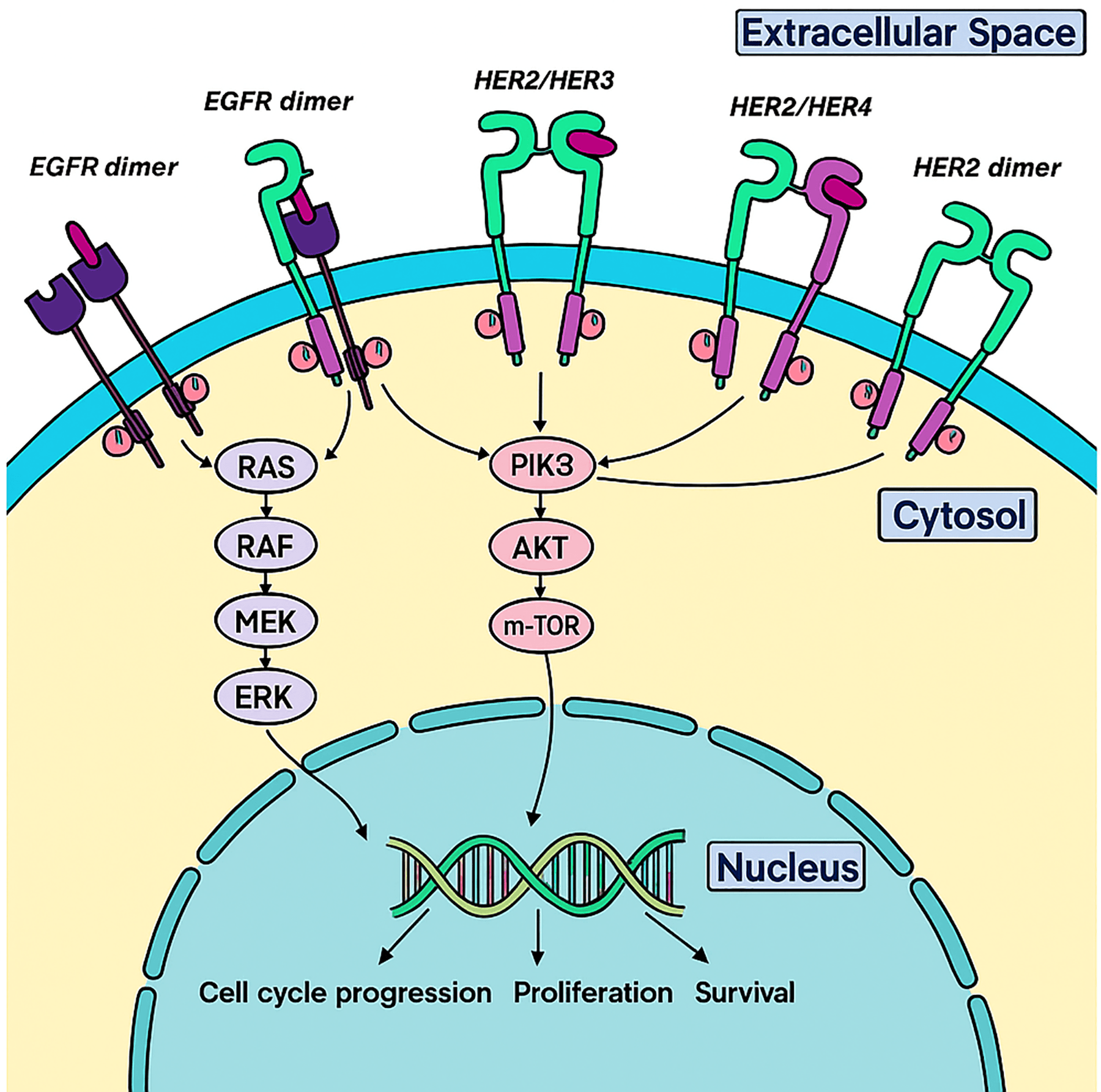
Figure 1. Downstream signaling pathway of the HER2 receptor.
Importantly, a subset of tumors exhibits both HER2 mutation and gene amplification, suggesting a potential synergistic mechanism driving oncogenesis. These dual alterations may lead to enhanced HER2 signaling, increased receptor dimerization, and stronger activation of downstream pathways, contributing to therapeutic resistance and aggressive disease behavior.19 Co-existing HER2 mutations and amplifications have been reported in various tumor types, including NSCLC and breast cancer, and are associated with differential responses to targeted therapies.20 Their identification underscores the need for comprehensive molecular profiling using NGS to guide optimal treatment selection. HER2 mutations represent a rare but clinically significant molecular subset of NSCLC, occurring in ~2%–4% of cases and up to ~5.1% in EGFR/KRAS/ALK-negative adenocarcinomas.21 In Chinese cohorts (2019–2024), NGS detected HER2 mutations in 3.8%–5.6% of cases, demonstrating higher sensitivity than PCR-based methods.22
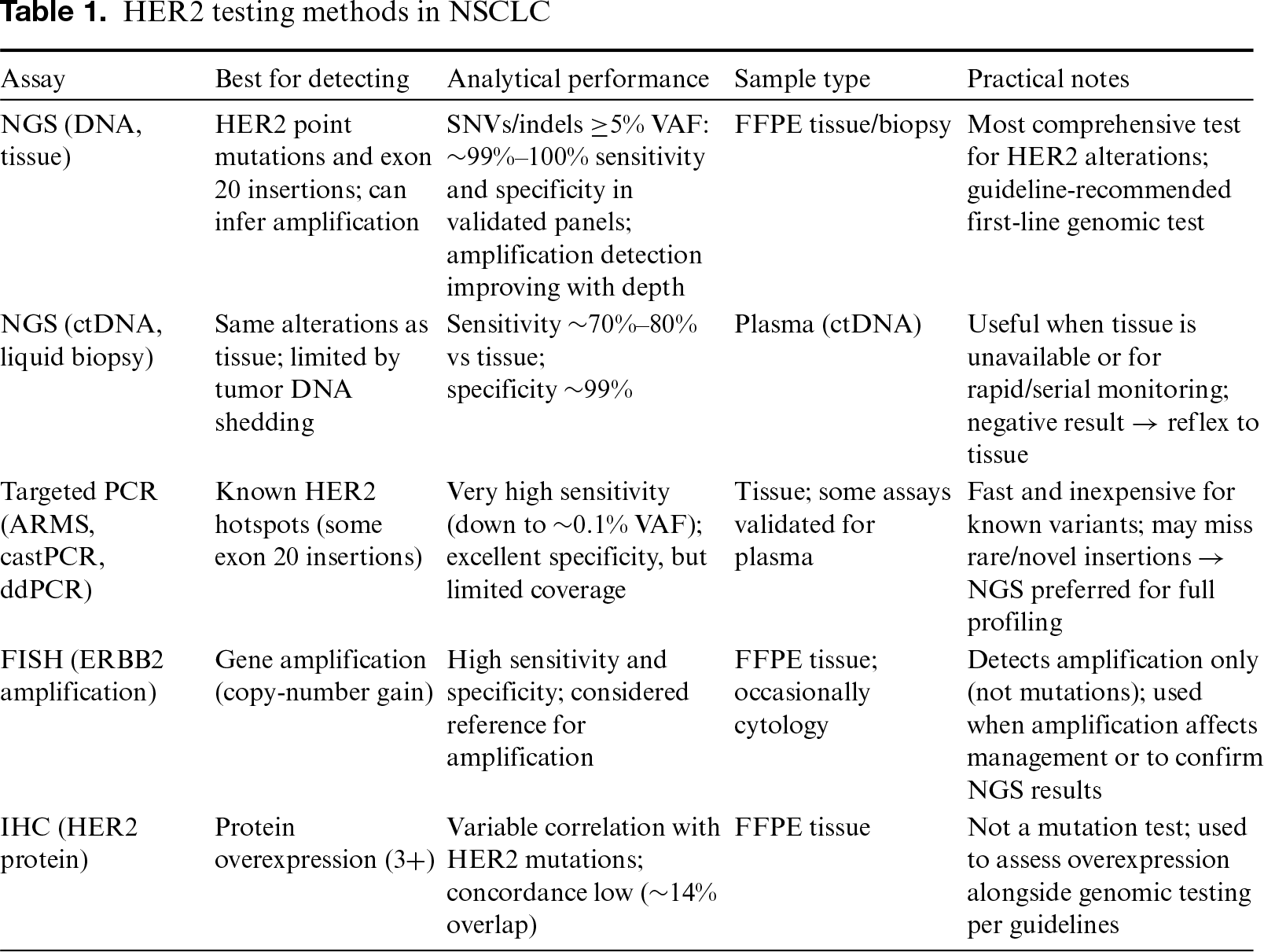
HER2 testing in NSCLC relies on complementary laboratory methods. NGS on tissue DNA is the most comprehensive and guideline-recommended first-line approach, accurately detecting HER2 point mutations and exon 20 insertions with near-perfect sensitivity and specificity (Table 1). NGS using circulating tumor DNA from plasma, also called liquid biopsy, offers a noninvasive alternative for rapid or serial testing, though its sensitivity is lower (around 70%–80%), and a negative result should be followed up with tissue testing when possible. Targeted polymerase chain reaction (PCR) assays, including amplification-refractory mutation system, competitive allele-specific TaqMan PCR, and droplet digital PCR, are extremely sensitive and specific for known HER2 hotspot variants but may miss rare or novel alterations, making them best suited for focused screening rather than comprehensive profiling. Fluorescence in situ hybridization remains the reference method for detecting ERBB2 gene amplification (copy-number gain) and is useful when amplification affects treatment decisions or to confirm NGS findings. Immunohistochemistry assesses HER2 protein overexpression but correlates poorly with ERBB2 genomic alterations, serving as a complementary test for evaluating protein expression rather than detecting mutations or insertions.
Interest in mutation-driven HER2 NSCLC has grown due to its limited response to conventional therapies and the development of targeted treatment options. NSCLC characterized by HER2 mutations or overexpression defines a distinct and aggressive molecular subtype that has historically been resistant to chemotherapy and immunotherapy.16 The advent of antibody–drug conjugates (ADCs) has transformed treatment. By combining HER2-targeted antibodies with cytotoxic payloads, ADCs enable selective tumor cell killing and exert a bystander effect, demonstrating promising efficacy, durable responses, and manageable safety profiles in heavily pretreated patients.23 HER2-directed tyrosine kinase inhibitors (TKIs) have historically shown limited efficacy due to structural challenges posed by exon 20 insertions and HER2’s unique kinase conformation.24 However, next-generation, mutation-selective TKIs now demonstrate encouraging activity in both treatment-naïve and previously treated patients, marking a paradigm shift in the management of HER2-altered NSCLC.
ADCs
Trastuzumab Deruxtecan (T-DXd)
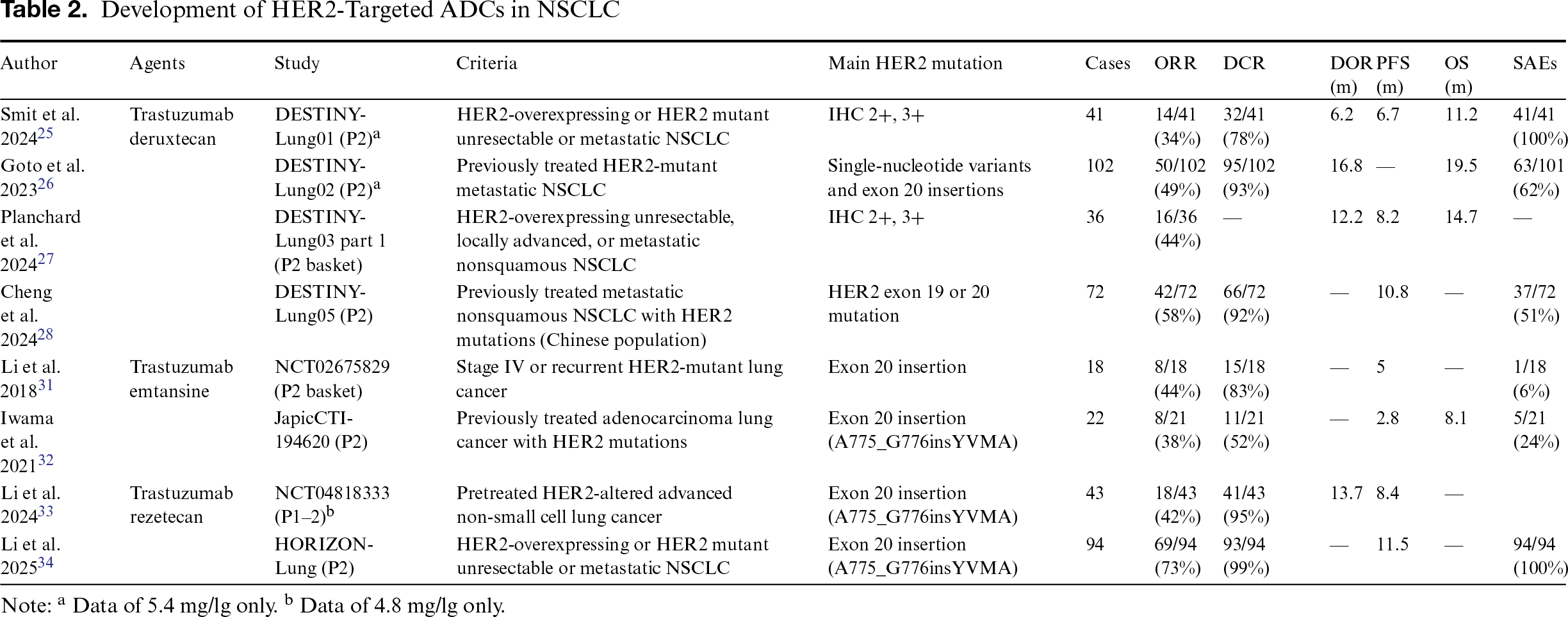
T-DXd has emerged as the most extensively studied HER2-targeted ADC, showing consistent and robust activity across multiple clinical trials (Table 2). In the DESTINY-Lung01 Phase II study, which enrolled patients with HER2-overexpressing or HER2-mutant unresectable or metastatic NSCLC exhibiting IHC scores of 2+ or 3+, T-DXd achieved an objective response rate (ORR) of 34% (14/41) and a disease control rate (DCR) of 78% (32/41), with a median duration of response (DOR) of 6.2 months, progression-free survival (PFS) of 6.7 months, and overall survival (OS) of 11.2 months.25 In the DESTINY-Lung02 Phase II study, which specifically targeted previously treated HER2-mutant metastatic NSCLC, the agent demonstrated even greater efficacy, achieving an ORR of 49% (50/102) and a DCR of 93%, with a median DOR of 16.8 months and OS of 19.5 months.26 Similarly, the DESTINY-Lung03 Phase II basket trial, focusing on HER2-overexpressing non-squamous NSCLC, reported an ORR of 44% (16/36), a median DOR of 12.2 months, and an OS of 14.7 months.27 Data from the DESTINY-Lung05 Phase II trial, conducted in a Chinese cohort with HER2 exon 19 or 20 mutations, revealed an even higher ORR of 58% (42/72), a DCR of 92%, and a median PFS of 10.8 months.28
Building on these results, ongoing trials are evaluating T-DXd in earlier treatment settings and broader patient populations. The pivotal DESTINY-Lung04 Phase III trial (NCT04644237) compares first-line T-DXd with platinum–pemetrexed chemotherapy, with or without pembrolizumab, in patients with unresectable or metastatic HER2-mutant nonsquamous NSCLC.29 Additional studies, such as DESTINY-Lung06, are exploring its role in HER2-expressing tumors with lower levels of HER2 and in combination with ICI.30 These trials aim to establish T-DXd not only as the standard treatment in previously treated settings but also potentially as a first-line option.
Trastuzumab Emtansine (T-DM1)
T-DM1, an earlier-generation HER2-directed ADC, has shown meaningful, though comparatively modest, activity. In a Phase II basket study (NCT02675829) enrolling patients with Stage IV or recurrent HER2-mutant NSCLC harboring exon 20 insertions, T-DM1 achieved an ORR of 44% (8/18) and a DCR of 83%, with a median PFS of 5 months.31 Similarly, the Japanese Phase II trial JapicCTI-194620 evaluated T-DM1 in previously treated patients with adenocarcinoma harboring exon 20 insertions and reported an ORR of 38% (8/21), a DCR of 52%, a median PFS of 2.8 months, and an OS of 8.1 months.32 Despite these promising findings, T-DM1’s clinical utility is limited by a shorter DOR and lower efficacy compared with T-DXd. Consequently, its role is evolving, primarily as an alternative in regions where T-DXd is unavailable or as part of combinatorial strategies currently under investigation.
Trastuzumab Rezetecan
Trastuzumab rezetecan represents a next-generation HER2-directed ADC with encouraging clinical outcomes. In the Phase I–II study (NCT04818333), pretreated patients with HER2-altered advanced NSCLC, including those harboring exon 20 insertions and overexpression, achieved an ORR of 42% (18/43) and an impressive DCR of 95%, with a median DOR of 13.7 months and PFS of 8.4 months.33 More recent results from the HORIZON-Lung Phase II trial, published in 2025, demonstrated even greater efficacy: an ORR of 73% (69/94), a DCR of 99%, and a median PFS of 11.5 months.34 These findings position trastuzumab rezetecan as a potential alternative or complement to T-DXd, especially in HER2-mutant NSCLC. Expansion cohorts within the HORIZON-Lung program are currently investigating its role in earlier lines of therapy and in combination regimens, while global Phase III studies are being planned to confirm these promising outcomes.
Emerging HER2-Targeted ADCs
In addition to the agents listed in Table 2, several novel HER2-directed ADCs are rapidly advancing through clinical development. Disitamab vedotin (RC48) is currently being evaluated in the DV-005 Phase II trial for HER2-expressing NSCLC and is also under investigation in combination with agents such as bevacizumab and ICIs to enhance therapeutic synergy.35 MRG002, a trastuzumab–vedotin-based ADC, is in Phase II evaluation (NCT05141786) for patients with HER2-mutant unresectable or metastatic NSCLC.36 Other innovative ADCs include SYD985 (trastuzumab duocarmazine), which utilizes a duocarmazine payload to enhance DNA damage, and ARX788, a site-specific conjugated ADC designed to improve the therapeutic index and reduce off-target toxicity.37,38 Early-phase studies of these agents are ongoing globally and are expected to diversify the ADC landscape for HER2-altered NSCLC.
ADCs have transformed the treatment landscape for HER2-altered NSCLC. T-DXd demonstrates the strongest and most durable efficacy, establishing it as the preferred option for previously treated patients, with ongoing trials exploring its use in first-line settings. Trastuzumab rezetecan shows promising activity and may complement or potentially rival T-DXd, pending results from Phase III trials. Meanwhile, T-DM1 remains relevant in select cases but has largely been surpassed by newer ADCs. Next-generation ADCs, including disitamab vedotin, MRG002, SYD985, and ARX788, aim to improve potency, safety, and combination strategies. Ongoing studies will clarify optimal sequencing, HER2 status-based patient selection, and personalized treatment approaches. Front-line trials such as DESTINY-Lung04 may establish T-DXd as the standard therapy. Promising agents (rezetecan and RC48) and combination regimens with TKIs or immunotherapy are under evaluation. Priorities include genotype-guided therapy, an improved understanding of resistance mechanisms, dose optimization, and broader global access, alongside expanding research beyond exon 20 mutations to include HER2 amplification and overexpression.
Serious Adverse Events (SAEs)
HER2-targeted ADCs have significantly improved clinical outcomes, but their safety profiles require ongoing and careful evaluation. In clinical trials for NSCLC, SAEs were common. They occurred in about 50%–100% of patients treated with T-DXd, 6%–24% with T-DM1, and up to 100% in early-phase studies of trastuzumab rezetecan (Table 2). These findings highlight the need for close safety monitoring and individualized toxicity management. Interstitial lung disease (ILD) or pneumonitis is a major concern and can be life-threatening. It has been reported in up to 10%–15% of patients receiving T-DXd, with Grade ≥3 events seen in a smaller proportion.39 Although overt cardiotoxicity is uncommon with T-DXd, regular cardiac evaluation is recommended.40 T-DM1 demonstrates a more predictable and generally manageable safety profile, with reported SAEs including hepatotoxicity, more frequent declines in left ventricular ejection fraction, and, rarely, ILD, relative to T-DXd.41 Effective use of HER2-targeted ADCs requires proactive monitoring. Regular blood counts, liver function testing, and prompt assessment of new or worsening respiratory symptoms are essential. Coordination among oncologists, pulmonologists, and cardiologists supports early intervention, dose modification, or treatment interruption to preserve efficacy and reduce toxicity.
TKIs
Afatinib
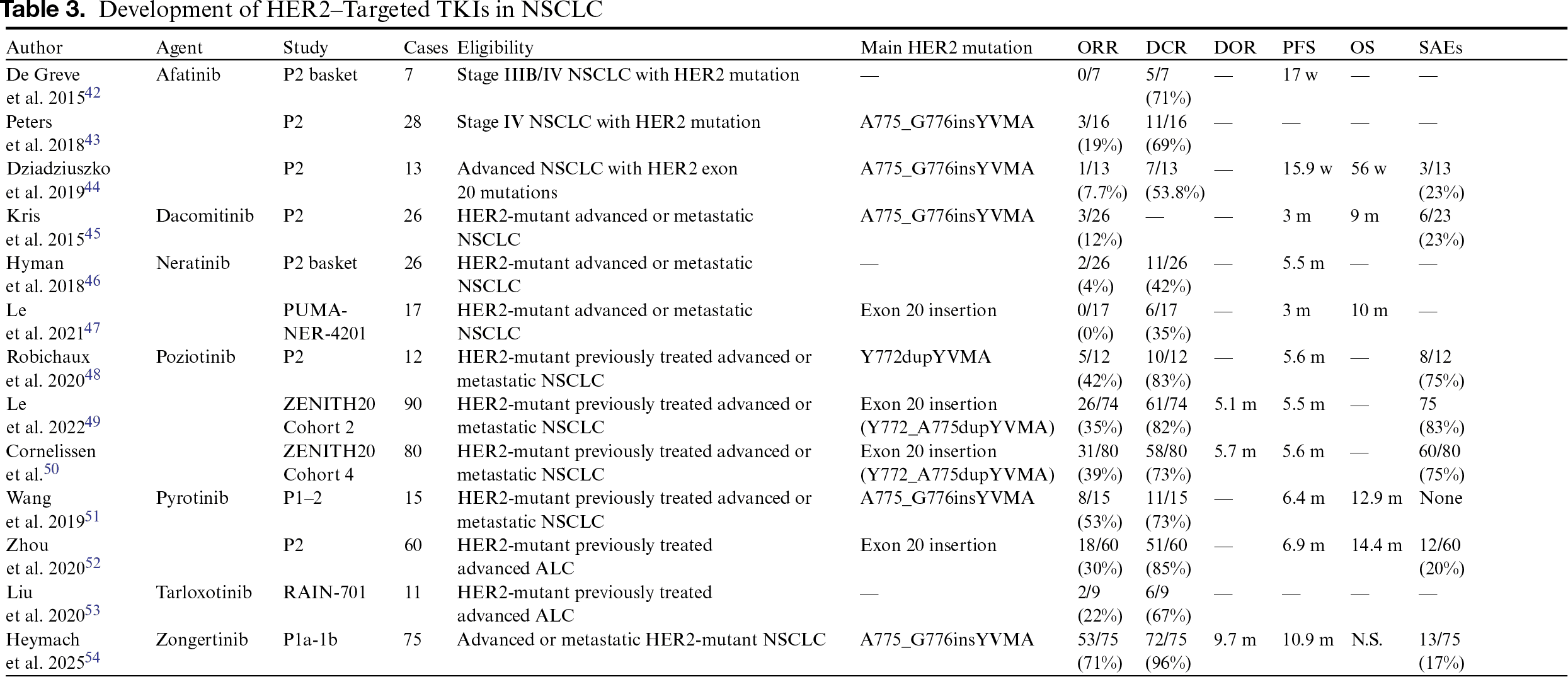
Afatinib, an irreversible pan-HER inhibitor, was among the earliest TKIs tested in HER2-mutant NSCLC. In a Phase II basket trial conducted by De Greve et al., seven patients with Stage IIIB/IV HER2-mutant NSCLC were treated; however, no objective responses were observed (Table 3). Despite this, a DCR of 71% was reported, with a median PFS of 17 weeks.42 Similarly, in a Phase II study by Peters et al. evaluating afatinib in 28 patients with Stage IV NSCLC harboring A775_G776insYVMA exon 20 insertions, only 3 of 16 evaluable patients (19%) achieved a partial response, while the majority exhibited stable disease.43 Dziadziuszko et al. evaluated 13 patients, reporting an ORR of 7.7%.44 Collectively, afatinib demonstrated modest efficacy and limited durability of response, which restricts its use in modern clinical practice.
Dacomitinib
Dacomitinib, another irreversible pan-HER inhibitor, was evaluated in a Phase II trial conducted by Kris et al., which enrolled 26 patients with HER2-mutant advanced or metastatic NSCLC. The ORR was 12% (3/26), with a median PFS of 3 months and an OS of 9 months. Six patients (23%) experienced SAEs of more than Grade 2, underscoring the safety limitations of this agent.45 Given its modest efficacy and relatively unfavorable toxicity profile, dacomitinib has largely fallen out of favor compared to newer, mutation-specific HER2 TKIs.
Neratinib
Neratinib, an irreversible pan-HER inhibitor, has demonstrated limited clinical benefit in HER2-mutant NSCLC. In a Phase II basket trial led by Hyman et al., only 2 of 26 patients (4%) achieved a partial response, and the DCR was 42%, with a median PFS of 5.5 months.46 Similarly, the PUMA-NER-4201 study by Le et al. reported no objective responses among 17 enrolled patients with exon 20 insertions, although 35% achieved stable disease, with a median PFS of 3 months.47 Due to these disappointing results, neratinib development in NSCLC has largely stalled; however, ongoing studies are exploring combination strategies to overcome resistance mechanisms.
Poziotinib
Poziotinib, an oral, irreversible pan-HER inhibitor, represents one of the first TKIs to demonstrate meaningful clinical activity against HER2 exon 20 insertions. In a Phase II study by Robichaux et al., poziotinib achieved an ORR of 42% (5/12) and a DCR of 83%, with a median PFS of 5.6 months.48 These encouraging findings were confirmed in the ZENITH20 multicohort Phase II trial. In Cohort 2, which included 90 patients with previously treated HER2-mutant advanced NSCLC, poziotinib demonstrated an ORR of 35% (26/74) and a DCR of 82%, with a median DOR of 5.1 months and a median PFS of 5.5 months.49 Similarly, Cohort 4 enrolled 80 previously treated HER2-mutant patients and reported an ORR of 39% (31/80) and a DCR of 73%, with a median PFS of 5.6 months.50 However, poziotinib’s clinical use has been limited by frequent Grade ≥3 toxicities and high rates of SAEs (reported in up to 75% of patients), prompting further optimization of dosing strategies.
Pyrotinib
Pyrotinib, an irreversible pan-HER TKI developed in China, has shown robust efficacy in HER2-mutant NSCLC, particularly in cases with exon 20 insertions. In an early Phase I/II trial conducted by Wang et al., pyrotinib achieved an ORR of 53% (8/15) and a DCR of 73%, with a median PFS of 6.4 months and an OS of 12.9 months.51 Subsequent Phase II data from Zhou et al., involving 60 patients with exon 20 insertions, confirmed an ORR of 30% and a DCR of 85%, with a median PFS of 6.9 months and an OS of 14.4 months. Importantly, pyrotinib demonstrated a more manageable safety profile compared to poziotinib, with lower rates of SAEs (~20%).52 Ongoing studies are evaluating pyrotinib in earlier lines of therapy and in combination regimens with ICIs and chemotherapy, positioning it as a promising treatment option for HER2-mutant NSCLC, particularly within Asian populations.
Tarloxotinib
Tarloxotinib is a novel hypoxia-activated pan-HER TKI designed to selectively release its active metabolite within hypoxic tumor microenvironments (TMEs), potentially reducing systemic toxicity. In the RAIN-701 study, 11 patients with previously treated HER2-mutant advanced lung cancer were enrolled. Among the nine evaluable patients, two partial responses (22%) were observed, and the DCR was 67%.53 While these findings are preliminary, tarloxotinib remains an intriguing investigational agent that requires further clinical validation.
Zongertinib
Zongertinib represents a next-generation, highly selective HER2 TKI optimized for activity against exon 20 insertions while minimizing off-target effects. In the Phase Ia/b trial presented by Heymach et al. in 2025, 75 patients with advanced or metastatic HER2-mutant NSCLC, predominantly harboring A775_G776insYVMA insertions, were treated. Remarkably, zongertinib achieved an ORR of 71% (53/75) and a DCR of 96%, with a median DOR of 9.7 months and a PFS of 10.9 months. SAEs occurred in 17% of patients, indicating a favorable safety profile relative to earlier-generation TKIs.54 These promising data suggest that zongertinib may represent the most effective HER2-directed TKI to date, and ongoing Phase II/III studies are expected to further define its role in clinical practice.
Discussion
The development of HER2-targeted TKIs has progressed from nonselective pan-HER inhibitors with modest efficacy, such as afatinib, dacomitinib, and neratinib, to next-generation, mutation-selective agents that demonstrate significantly improved response rates and tolerability, including poziotinib, pyrotinib, and zongertinib.55 Among these, zongertinib is emerging as a potential best-in-class TKI, with efficacy approaching that of ADCs like T-DXd, which has been approved by the Food and Drug Administration (Table S1).56 Future strategies will focus on optimizing patient selection, refining HER2 mutational profiling to distinguish exon-specific sensitivities, and investigating combination regimens that integrate TKIs with ADCs, ICIs, and chemotherapy. As clinical data mature, personalized treatment algorithms will increasingly leverage both targeted TKIs and ADCs to improve outcomes for patients with HER2-altered NSCLC.
Although ADCs such as T-DXd often induce more durable and profound responses compared with TKIs, the development of resistance remains inevitable. Resistance to HER2-targeted therapies in HER2-altered NSCLC arises from multiple, often overlapping mechanisms (Table 4). Structural alterations of the HER2 receptor, including secondary mutations, truncations, or heterogeneous expression, can impair drug binding and reduce treatment efficacy. Tumor cells may activate alternative or bypass signaling pathways, such as EGFR, HER3, MET, or FGFR, to sustain growth despite HER2 inhibition. Acquired downstream mutations in genes such as PIK3CA or KRAS can further drive resistance through persistent activation of the PI3K/AKT or MAPK pathways.57–59 Immune-mediated resistance may occur through reduced antibody-dependent cellular cytotoxicity or increased immunosuppression in the TME. In addition, impaired drug internalization, increased efflux, or altered lysosomal processing can decrease the cytotoxic payload delivery of ADCs.60 Phenotypic plasticity, including epithelial–mesenchymal transition, enables tumor cells to become less dependent on HER2 signaling, while intratumoral heterogeneity and clonal evolution promote the emergence of resistant subclones.61 Together, these mechanisms highlight the complexity of HER2 resistance and underscore the need for dynamic molecular monitoring and combination strategies to overcome therapeutic failure.
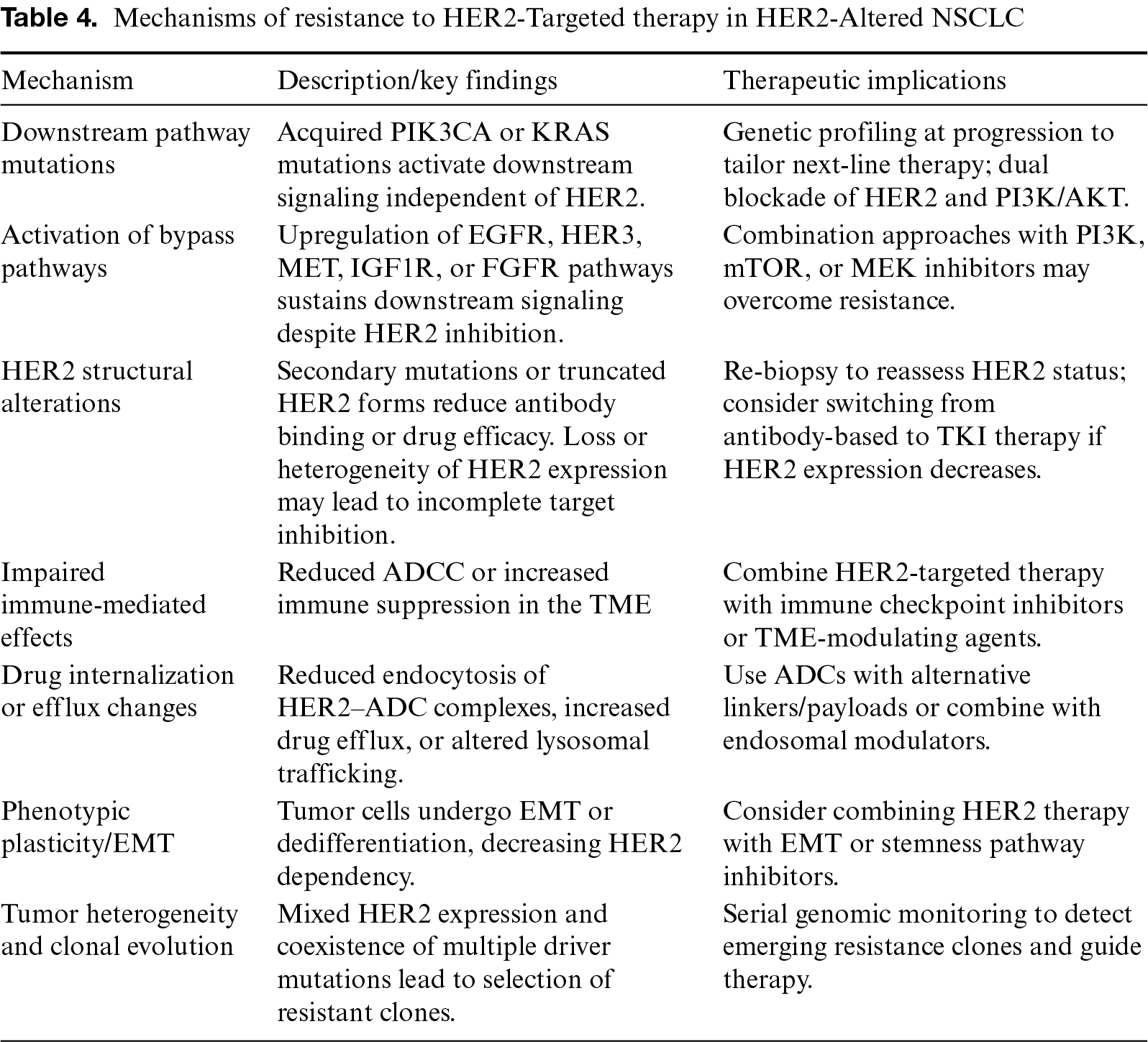
Cross-resistance between ADCs and TKIs appears to be incomplete. This finding supports the rationale for sequential or combination therapy. Patients who progress on T-DXd may still respond to subsequent TKI treatment, and the reverse may also occur. Treatment choice should be guided by the dominant molecular resistance mechanisms identified at progression. Molecular re-profiling is critical to inform therapy sequencing, overcome resistance, and achieve sustained disease control. Safety remains a key consideration. Both ADCs and TKIs continue to advance, with newer generations improving efficacy and tolerability. Agents such as pyrotinib and zongertinib illustrate ongoing progress toward safer and more effective HER2-targeted options for mutation-specific patient populations.
Meanwhile, next-generation TKIs such as zongertinib and pyrotinib are undergoing late-phase evaluation, including trials combining TKIs with ICIs and chemotherapy to enhance response depth and durability. Combination approaches involving ADCs plus TKIs or ADCs plus immunotherapy are also under exploration to maximize tumor control and delay resistance. Moreover, genotype-guided treatment strategies that distinguish HER2 exon 20 insertions from HER2 overexpression/amplification will refine patient selection and therapeutic decision-making.
Conclusion
Therapeutic strategies for HER2-altered NSCLC are rapidly advancing. T-DXd remains the current standard of care, demonstrating strong and durable efficacy. Meanwhile, trastuzumab rezetecan and other emerging ADCs show comparable promise. Next-generation TKIs, particularly zongertinib and pyrotinib, offer improved efficacy and safety profiles compared to earlier agents. Future treatments will rely on personalized, biomarker-driven approaches that integrate optimized sequencing and combination strategies to enhance outcomes and overcome resistance.
Acknowledgment
None.
Funding Source
None.
Author Contributions
M.I. contributed to the study design, manuscript drafting, literature search, quality assessment, data extraction, and analysis. S.T., T.H., Y.I., K.W., and N.S. contributed to data interpretation and manuscript revision. All authors have read and approved the final manuscript and agree with its content and data.
Data Availability
The corresponding author will make the datasets available upon reasonable request.
Ethical Statement
Institutional Review Board approval was waived due to the nature of this meta-analysis.
Conflict of Interest
The authors declare no conflicts of interest related to this work.
Supplemental Information
Supplemental information for this article can be found online at https://sup.jclinque.com/api/articles/92/download-suppl.
References
[1] Li C, Lei S, Ding L, et al. Global burden and trends of lung cancer incidence and mortality. Chin Med J (Engl). July 5, 2023;136(13):1583–1590. doi:10.1097/cm9.0000000000002529.
[2] Elmadani M, Mokaya PO, Omer AAA, Kiptulon EK, Klara S, Orsolya M. Cancer burden in Europe: a systematic analysis of the GLOBOCAN database (2022). BMC Cancer. March 12, 2025;25(1):447. doi:10.1186/s12885-025-13862-1.
[3] Verma SK, Pandey M, Khare R, Singh D. A review on non-small cell lung cancer. Vacunas (English Edition). April 01, 2024;25(2):239–253. doi:10.1016/j.vacune.2024.05.013.
[4] Chopra D, Waterhouse DM, Sultan I, Stollenwerk B. Real-world treatment patterns, healthcare resource utilization, and healthcare costs in the first-line treatment of metastatic non-small cell lung cancer in the US. Curr Oncol. March 5, 2025;32(3):151. doi:10.3390/curroncol32030151.
[5] Kim Y, Zhu Y, Moore KJ, et al. Economic burden and provider referral patterns among patients with unresectable stage III EGFR-mutated NSCLC receiving chemoradiotherapy in the United States. Adv Ther. July 2025;42(7):3505–3527. doi:10.1007/s12325-025-03239-y.
[6] Liu B, Zhou H, Tan L, Siu KTH, Guan XY. Exploring treatment options in cancer: tumor treatment strategies. Signal Transduct Target Ther. July 17, 2024;9(1):175. doi:10.1038/s41392-024-01856-7.
[7] Zafar A, Khatoon S, Khan MJ, Abu J, Naeem A. Advancements and limitations in traditional anti-cancer therapies: a comprehensive review of surgery, chemotherapy, radiation therapy, and hormonal therapy. Discov Oncol. April 24, 2025;16(1):607. doi:10.1007/s12672-025-02198-8.
[8] Li J, Gong C, Zhou H, et al. Kinase inhibitors and kinase-targeted cancer therapies: recent advances and future perspectives. Int J Molec Sci. 2024;25(10):5489. doi:10.3390/ijms25105489.
[9] Huang Q, Li Y, Huang Y, et al. Advances in molecular pathology and therapy of non-small cell lung cancer. Signal Transduct Target Ther. June 15, 2025;10(1):186. doi:10.1038/s41392-025-02243-6.
[10] Passaro A, Al Bakir M, Hamilton EG, et al. Cancer biomarkers: emerging trends and clinical implications for personalized treatment. Cell. March 28, 2024;187(7):1617–1635. doi:10.1016/j.cell.2024.02.041.
[11] Gosney JR, Paz-Ares L, Jänne P, et al. Pathologist-initiated reflex testing for biomarkers in non-small-cell lung cancer: expert consensus on the rationale and considerations for implementation. ESMO Open. August 2023;8(4):101587. doi:10.1016/j.esmoop.2023.101587.
[12] Treichler G, Hoeller S, Rueschoff JH, et al. Improving the turnaround time of molecular profiling for advanced non-small cell lung cancer: outcome of a new algorithm integrating multiple approaches. Pathol-Res Pract. September 01, 2023;248:154660. doi:10.1016/j.prp.2023.154660.
[13] Garinet S, Lupo A, Denize T, et al. Successive next-generation sequencing strategy for optimal fusion gene detection in non-small-cell lung cancer in clinical practice. Pathology. September 01, 2024;56(5):702–709. doi:10.1016/j.pathol.2024.02.014.
[14] Yin L, Zhang H, Shang Y, Wu S, Jin T. ErbB/HER family in cancer immunology: therapeutic advances and mechanisms. Drug Discov Today. July 24, 2025;30(9):104436. doi:10.1016/j.drudis.2025.104436.
[15] Pan L, Li J, Xu Q, et al. HER2/PI3K/AKT pathway in HER2-positive breast cancer: a review. Medicine (Baltimore). June 14, 2024;103(24):e38508. doi:10.1097/md.0000000000038508.
[16] Nogueira CD, Frota S, Chaves HL, et al. Molecular landscape of HER2-mutated non-small cell lung cancer in Northeastern Brazil: clinical, histopathological, and genomic insights. Oncotarget. June 17, 2025;16:467–479. doi:10.18632/oncotarget.28737.
[17] Tu HY, Yin K, Zhao X, et al. Genomic and immune characteristics of HER2-mutated non-small-cell lung cancer and response to immune checkpoint inhibitor-based therapy. Mol Oncol. August 2023;17(8):1581–1594. doi:10.1002/1878-0261.13439.
[18] Riudavets M, Sullivan I, Abdayem P, Planchard D. Targeting HER2 in non-small-cell lung cancer (NSCLC): a glimpse of hope? An updated review on therapeutic strategies in NSCLC harbouring HER2 alterations. ESMO Open. October 2021;6(5):100260. doi:10.1016/j.esmoop.2021.100260.
[19] Wang D, Chen X, Du Y, et al. Associations of HER2 mutation with immune-related features and immunotherapy outcomes in solid tumors. Front Immunol. 2022;13:799988. doi:10.3389/fimmu.2022.799988.
[20] Nagasaka M, Singh V, Baca Y, et al. The effects of HER2 alterations in EGFR mutant non-small cell lung cancer. Clin Lung Cancer. 2022;23(1):52–59. doi:10.1016/j.cllc.2021.08.012.
[21] Bontoux C, Benzaquen J, Hofman V, et al. Deciphering the impact of HER2 alterations on non-small-cell lung cancer: from biological mechanisms to therapeutic approaches. J Pers Med. October 4, 2022;12(10):1651. doi:10.3390/jpm12101651.
[22] Liu C, Li T, Cui X, et al. Advances and future perspectives of HER2 mutations in non-small lung cancer (NSCLCEspecially in China. Cancer Control. January–December 2025;32:10732748251347572. doi:10.1177/10732748251347572.
[23] Rassy E, Rached L, Pistilli B. Antibody drug conjugates targeting HER2: clinical development in metastatic breast cancer. Breast. December 2022;66:217–226. doi:10.1016/j.breast.2022.10.016.
[24] Topalan E, Büyükgüngör A, Çiğdem M, et al. A structural insight into two important ErbB receptors (EGFR and HER2) and their relevance to non-small cell lung cancer. Arch Pharm (Weinheim). April 2025;358(4):e2400992. doi:10.1002/ardp.202400992.
[25] Smit EF, Felip E, Uprety D, et al. Trastuzumab deruxtecan in patients with metastatic non-small-cell lung cancer (DESTINY-Lung01): primary results of the HER2-overexpressing cohorts from a single-arm, phase 2 trial. Lancet Oncol. April 2024;25(4):439–454. doi:10.1016/s1470-2045(24)00064-0.
[26] Goto K, Goto Y, Kubo T, et al. Trastuzumab deruxtecan in patients with HER2-mutant metastatic non-small-cell lung cancer: primary results from the randomized, phase II DESTINY-Lung02 trial. J Clin Oncol. November 1, 2023;41(31):4852–4863. doi:10.1200/jco.23.01361.
[27] Planchard D, Kim HR, Suksombooncharoen T, et al. Trastuzumab deruxtecan monotherapy in pretreated HER2-overexpressing nonsquamous non-small cell lung cancer: DESTINY-Lung03 part 1. J Thoracic Oncol. October 01, 2024;19(10, Supplement):S46–S47. doi:10.1016/j.jtho.2024.09.082.
[28] Cheng Y, Wu L, Fang Y, et al. Trastuzumab deruxtecan (T-DXd) in Chinese patients (pts) with previously treated HER2 mutant non-small cell lung cancer (NSCLC): primary analysis from the Phase 2 DESTINY-Lung05 (DL-05) trial. Cancer Res. 2024;84(7_Supplement):CT248. doi:10.1158/1538-7445.Am2024-ct248.
[29] Li BT, Ahn M-J, Goto K, et al. Open-label, randomized, multicenter, phase 3 study evaluating trastuzumab deruxtecan (T-DXd) as first-line treatment in patients with unresectable, locally advanced, or metastatic non-small cell lung cancer (NSCLC) harboring HER2 exon 19 or 20 mutations (DESTINY-Lung04). J Clinical Oncol. June 01, 2022;40(16_suppl):TPS9137. doi:10.1200/JCO.2022.40.16_suppl.TPS9137.
[30] Daiichi Sankyo. A Phase 3, Multicenter, Randomized, Open-label Trial of Trastuzumab Deruxtecan in Combination With Pembrolizumab Versus Platinum-based Chemotherapy in Combination With Pembrolizumab, as First-line Therapy in Participants With Locally Advanced Unresectable or Metastatic HER2 Overexpressing and PD-L1 TPS <50% Non-squamous Non-small Cell Lung Cancer (DESTINY-Lung06). ClinicalTrials.gov identifier: NCT06899126. 2025. Updated September 22, 2025. Accessed October 1, 2025. https://clinicaltrials.gov/study/NCT06899126.
[31] Li BT, Shen R, Buonocore D, et al. Ado-trastuzumab emtansine for patients with HER2-mutant lung cancers: results from a phase II basket trial. J Clin Oncol. August 20, 2018;36(24):2532–2537. doi:10.1200/jco.2018.77.9777.
[32] Iwama E, Zenke Y, Sugawara S, et al. Trastuzumab emtansine for patients with non-small cell lung cancer positive for human epidermal growth factor receptor 2 exon-20 insertion mutations. Eur J Cancer. February 2022;162(9):99–106. doi:10.1016/j.ejca.2021.11.021.
[33] Li Z, Song Z, Hong W, et al. SHR-A1811 (antibody-drug conjugate) in advanced HER2-mutant non-small cell lung cancer: a multicenter, open-label, phase 1/2 study. Signal Transduct Target Ther. July 15, 2024;9(1):182. doi:10.1038/s41392-024-01897-y.
[34] Li Z, Wang Y, Sun Y, et al. Trastuzumab rezetecan, a HER2-directed antibody drug conjugate, in patients with advanced HER2-mutant non-small-cell lung cancer (HORIZON-Lung): phase 2 results from a multicentre, single-arm study. Lancet Oncol. 2025;26(4):437–446. doi:10.1016/S1470-2045(25)00012-9.
[35] Chen J, Zhang X, Liu L, et al. Phase II study of disitamab vedotin (RC48) in combination with tislelizumab and bevacizumab in patients (Pts) with HER2 alterations locally advanced or metastatic NSCLC: primary analysis results of RESOLUTION. J Clinical Oncol. 2025;43(16_suppl):e20515. doi:10.1200/JCO.2025.43.16_suppl.e20515.
[36] Senxu Biotech. An Open-label, Multi-center, Non-randomized Phase II Clinical Study to Evaluate the Efficacy and Safety ofMRG002 in Patients With HER2-mutated Unresectable/Metastatic Non-small Cell Lung Cancer (NSCLC). ClinicalTrials.gov identifier: NCT05141786. Updated December 2, 2021. Accessed October 1, 2025. https://clinicaltrials.gov/study/NCT05141786.
[37] Coleman N, Yap TA, Heymach JV, Meric-Bernstam F, Le X. Antibody-drug conjugates in lung cancer: dawn of a new era? NPJ Precis Oncol. January 11, 2023;7(1):5. doi:10.1038/s41698-022-00338-9.
[38] Ambrx Inc. A global phase 2 study to evaluate the efficacy and safety of ARX788 for selected HER2-mutated or HER2-amplified/overexpressed solid tumors. ClinicalTrials.gov identifier: NCT05041972. Updated September 13, 2022. Accessed October 1, 2025. https://www.clinicaltrials.gov/study/NCT05041972.
[39] Liao D, Zhang J, Yan T, et al. A systematic review of mechanisms, incidence, and management of trastuzumab deruxtecan induced ILD/Pneumonitis in solid tumors. Drug Des Devel Ther. 2025;19:1655–1668. doi:10.2147/dddt.S508773.
[40] Hwang H-J, Han S-A, Sohn IS. Breast cancer and therapy-related cardiovascular toxicity. J Breast Cancer. June 2024;27(3):147–162. doi:10.4048/jbc.2024.0085.
[41] Ma P, Tian H, Shi Q, et al. High risks adverse events associated with trastuzumab emtansine and trastuzumab deruxtecan for the treatment of HER2-positive/mutated malignancies: a pharmacovigilance study based on the FAERS database. Expert Opin Drug Saf. July–December 2023;22(8):685–696. doi:10.1080/14740338.2023.2204228.
[42] De Grève J, Moran T, Graas MP, et al. Phase II study of afatinib, an irreversible ErbB family blocker, in demographically and genotypically defined lung adenocarcinoma. Lung Cancer. April 2015;88(1):63–69. doi:10.1016/j.lungcan.2015.01.013.
[43] Peters S, Curioni-Fontecedro A, Nechushtan H, et al. Activity of Afatinib in heavily pretreated patients with ERBB2 mutation-positive advanced NSCLC: findings from a global named patient use program. J Thorac Oncol. December 2018;13(12):1897–1905. doi:10.1016/j.jtho.2018.07.093.
[44] Dziadziuszko R, Smit EF, Dafni U, et al. Afatinib in NSCLC With HER2 mutations: results of the prospective, open-label phase II NICHE trial of european thoracic oncology platform (ETOP). J Thorac Oncol. June 2019;14(6):1086–1094. doi:10.1016/j.jtho.2019.02.017.
[45] Kris MG, Camidge DR, Giaccone G, et al. Targeting HER2 aberrations as actionable drivers in lung cancers: phase II trial of the pan-HER tyrosine kinase inhibitor dacomitinib in patients with HER2-mutant or amplified tumors. Ann Oncol. July 2015;26(7):1421–1427. doi:10.1093/annonc/mdv186.
[46] Hyman DM, Piha-Paul SA, Won H, et al. HER kinase inhibition in patients with HER2- and HER3-mutant cancers. Nature. February 8, 2018;554(7691):189–194. doi:10.1038/nature25475.
[47] Li B, Gandhi L, Besse B, et al. Neratinib-based combination therapy in HER2 mutant lung adenocarcinomas: findings from two international phase 2 studies. J Thoracic Oncoly. 2021;16(3):S234. doi:10.1016/j.jtho.2021.01.158.
[48] Robichaux JP, Elamin YY, Vijayan RSK, et al. Pan-cancer landscape and analysis of ERBB2 mutations identifies poziotinib as a clinically active inhibitor and enhancer of T-DM1 activity. Cancer Cell. March 16, 2020;37(3):420. doi:10.1016/j.ccell.2020.03.003.
[49] Le X, Cornelissen R, Garassino M, et al. Poziotinib in non-small-cell lung cancer harboring HER2 exon 20 insertion mutations after prior therapies: ZENITH20-2 trial. J Clin Oncol. March 1, 2022;40(7):710–718. doi:10.1200/jco.21.01323.
[50] Cornelissen R, Prelaj A, Sun S, et al. Poziotinib in treatment-naive NSCLC harboring HER2 exon 20 mutations: ZENITH20-4, a multicenter, multicohort, open-label, phase 2 trial (Cohort 4). J Thorac Oncol. August 2023;18(8):1031–1041. doi:10.1016/j.jtho.2023.03.016.
[51] Wang Y, Jiang T, Qin Z, et al. HER2 exon 20 insertions in non-small-cell lung cancer are sensitive to the irreversible pan-HER receptor tyrosine kinase inhibitor pyrotinib. Ann Oncol. March 1, 2019;1(3):447–455. doi:10.1093/annonc/mdy542.
[52] Zhou C, Li X, Wang Q, et al. Pyrotinib in HER2-mutant advanced lung adenocarcinoma after platinum-based chemotherapy: a multicenter, open-label, single-arm, phase II study. J Clinical Oncol. 2020;38(24):2753–2761. doi:10.1200/jco.20.00297.
[53] Liu SV, Villaruz LC, Lee VHF, et al. LBA61 First analysis of RAIN-701: study of tarloxotinib in patients with non-small cell lung cancer (NSCLC) EGFR Exon 20 insertion, HER2-activating mutations & other solid tumours with NRG1/ERBB gene fusions. Ann Oncol. 2020;31:S1189. doi:10.1016/j.annonc.2020.08.2294.
[54] Heymach JV, Ruiter G, Ahn MJ, et al. Zongertinib in previously treated HER2-mutant non-small-cell lung cancer. N Engl J Med. June 19, 2025;392(23):2321–2333. doi:10.1056/NEJMoa2503704.
[55] Ismail A, Desai A, Boumber Y. HER2 alterations in non-small cell lung cancer (NSCLC): from biology and testing to advances in treatment modalities. Front Oncol. 2025;15:1624124. doi:10.3389/fonc.2025.1624124.
[56] Heymach JV, Opdam F, Barve M, et al. HER2-selective tyrosine kinase inhibitor, zongertinib (BI 1810631in patients with advanced/metastatic solid tumors with HER2 alterations: a phase ia dose-escalation study. J Clin Oncol. April 10, 2025;10(11):1337–1347. doi:10.1200/jco-24-01727.
[57] Mo C, Sterpi M, Jeon H, Bteich F. Resistance to anti-HER2 therapies in gastrointestinal malignancies. Cancers (Basel). August 15, 2024;16(16):2854. doi:10.3390/cancers16162854.
[58] Abelman RO, Wu B, Spring LM, Ellisen LW, Bardia A. Mechanisms of resistance to antibody-drug conjugates. Cancers (Basel). February 17, 2023;15(4):1278. doi:10.3390/cancers15041278.
[59] Ocaña A, Amir E, Pandiella A. HER2 heterogeneity and resistance to anti-HER2 antibody-drug conjugates. Breast Cancer Res. January 31, 2020;22(1):15. doi:10.1186/s13058-020-1252-7.
[60] Chaigneau A, Grebenkov DS. First-passage times to anisotropic partially reactive targets. Phys Rev E. May 2022;105(5-1):054146. doi:10.1103/PhysRevE.105.054146.
[61] Lopez D, Tyson DR, Hong T. Intercellular signaling reinforces single-cell level phenotypic transitions and facilitates robust re-equilibrium of heterogeneous cancer cell populations. Cell Communicat Signal. September 28, 2025;23(1):386. doi:10.1186/s12964-025-02405-7.
 |
Copyright: © 2025 Ishihara et al. This work is licensed under a Creative Commons Attribution 4.0 International License, which permits unrestricted use, distribution, and reproduction in any medium, provided the original work is properly cited. |